Eight of Swords upright: how trapped are you really?
Upright, the card shows a person who cannot see and has stopped moving. Waite writes of "A woman, bound and hoodwinked, with the swords of the card about her," and then softens it at once: "Yet it is rather a card of temporary durance than of irretrievable bondage." Durance means confinement, and the word to keep is "temporary." Tarot.com files it as "the mental trap card" and adds that you are not stuck even though it feels that way. In your job this week, write down the three limits you treat as fixed and ask one person who would know whether each is a rule or a habit.
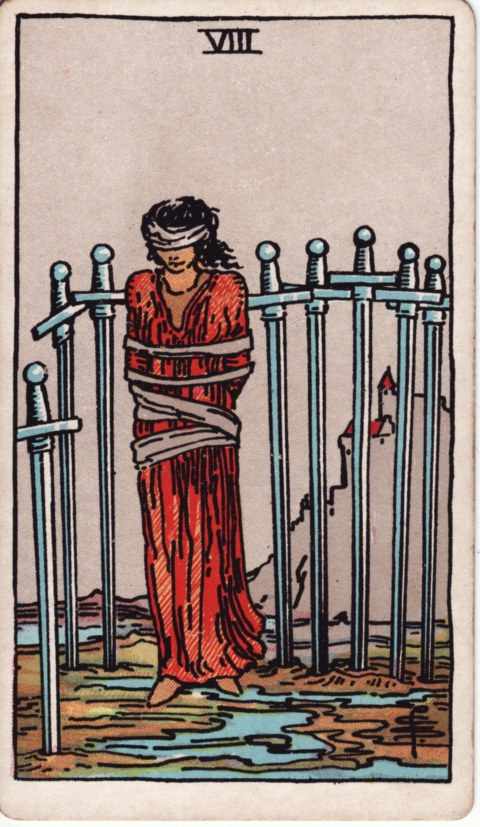
Look at what the picture leaves open. The front is clear, the cloth holds her arms but not her legs, and her feet are bare and free. Labyrinthos notices that whoever built the trap seems "a little lazy or hasty," and the swords bear that out: they stand around her sides and back, and none touches her. Biddy Tarot names what holds her "self-imposed bindings." So the card describes a bind partly made of the sitter's own conclusions about it.
Waite's list is harder than the picture, though: "Bad news, violent chagrin, crisis, censure, power in trammels, conflict, calumny; also sickness." Most of these are things that happen to a person. Ask whether a real event sits behind the feeling of being stuck, such as a rebuke, a rumor or a sudden bill. If one does, deal with that event first. A card cannot diagnose sickness; a doctor can.
Reversed Eight of Swords: blindfold off, or still on?
Reversed, the Eight of Swords splits two ways. In the first, the cloth slips: she lifts the blindfold, sees how much room there was, and starts to walk. In the second, the blindfold stays on and the fear goes quiet and habitual, an inner critic nobody hears any more. Waite's reversed list reads "Disquiet, difficulty, opposition, accident, treachery; what is unforeseen; fatality." These are outside shocks, and they fit a jolt that loosens the knots as well as one that tightens them. At work this week, take the limit you hit most often and spend fifteen minutes finding out what it really is: a policy, a price or one person's habit.
A quick test when the card comes up alone: write "I can't, because..." about the thing that feels shut. Then get one fact from outside your head, such as a price, a rule on paper, or the answer of someone who has done it. If the fact confirms the limit, the walls are real, and Waite's "temporary durance" says to plan the longer way around. If the fact is missing, or the answer is "you could just ask," the binding is a belief, and the first step is the question you have not put to anyone.
If you asked whether someone will come back, or whether a relative is about to leave, the card cannot say. Waite's shorter list gives the reversed card "Departure of a relative," a period remark with no picture behind it. What the card does show is how you stand while you wait, and waiting blindfolded for a message is something you can examine. If a relationship feels like a trap you cannot leave safely, a counselor or a local support service can help where a card cannot.
Is the Eight of Swords a yes or no card?
| Position | Answer |
|---|---|
| Upright | Not yet, look for the exits |
| Reversed | Yes, once the limit is tested |
Waite and Book T leave yes and no alone, so the answers on this page are modern practice. Upright, the Eight of Swords leans no for now. The question comes from inside a belief that there is no way out, and the answer may change once that belief is tested.
Reversed, expect a yes if the limit survives a fact check. Run the "I can't, because" test from the reversed section. If the limit proves to be a belief, the plan you doubted is usually possible. If the limit is real, the answer is not yet, by a different route.
Eight of Swords in love and friendship: feeling boxed in, single, their view
In a relationship
For a couple, the card often shows someone who feels boxed in and has not said so: a pattern in the house, a role in the couple, a fear of how a request would land. Pick one specific limit ("we never...") and say it once, as a request. If you feel unsafe or controlled by a partner, that is a different matter from feeling stuck, and a trained advisor can help with it where a card cannot.
Single
On your own, the Eight usually rests on a belief about yourself that works like a rule: nobody will like me, I always pick wrong, I cannot go out alone. The blindfold is the habit of not looking at the evidence. A small test fits the picture: accept one invitation you would usually refuse, and compare what happened with what you predicted.
As feelings
Read as their feelings, it shows someone who feels stuck, unsure and a little frozen about you or about the situation. It does not show affection or its absence. Frozen people go quiet and stay put, which looks like indifference from outside. If you need an answer, ask one plain question and leave room for the reply.
Stuck in a friend group you've outgrown?
You keep showing up to the Friday dinners, laugh at the old jokes and feel boxed in without saying so. That is the Eight of Swords, and Waite's own verdict is mild: the card is one of "temporary durance", not a sentence for life. Often nobody in the group is holding you there. The blindfold is the belief that skipping the routine would cost you the friendships.
Reversed, the cloth slips and you see how much room there was, or the fear stays on and you keep nodding along. Turn down one dinner this month. Offer the friend you like best a coffee instead.
Reversed in love
With the card turned over, a pattern may be loosening: you said the hard thing, or left the old script. It can also mean the fear is still in charge and the relationship is arranged around not rocking the boat. The fact test applies here too: replace one "I can't say" with one question actually asked.
Eight of Swords at work and with money
At work the Eight of Swords fits a person who feels stuck in a role, a contract or a team and has stopped checking whether that is true. Book T supplies another reading, force spent on small things: "too much attention to detail at the expense of the principal and more important points." Someone can be polishing the minor task while the main decision waits. Work out which of the two describes you before you decide to quit.
On the money side, the card suits a budget or a debt you have not opened because it feels hopeless. Open it. A figure with a name and a date can be planned around, which a vague dread never allows. Reversed at work, either the stuck feeling lifts after you ask for what you needed, or it settles in as the voice that talks you out of applying, asking for a raise or sending the invoice. Reversed with money, find the one unpaid or unasked item you keep not looking at and put a day on it.
Eight of Swords as advice and as a person
Advice from this card: test one wall. Pick the limit that bothers you most, find out who set it and whether it can move, and ask the one question that would settle it. Taking off the blindfold is a small act, like a phone call or reading the contract again.
Drawn as a type, it shows someone who has decided there is no way out. Picture a woman we will call Mara, who has stayed six years in a job she dislikes because she assumes her skills do not transfer, and who has never applied anywhere. Mara is our invention. Book T gives the type a mixed portrait: "great care in some things, counterbalanced by equal disorder in others." Reversed as advice: stop waiting to feel certain. Check the one limit you have not checked, and let a fact decide whether to stay.
How to read the Eight of Swords in a spread
Drawn alone, the Eight of Swords asks which limit you have been obeying without testing. In the past position, look for the event that taught you the limit. In the present slot the blindfold is on today. In the outcome slot it warns of a stuck stretch that ends when something is tried, and as advice it says to take the cloth off in one small place.
Book T says "Swords are friendly with Cups and Wands," so a Cups card beside the Eight shows the feeling behind the fear, and a Wands card brings the energy to move. Book T lists Pentacles as inimical to Swords, so a coin card can sharpen the practical pressure of money or a place you cannot leave. In our own pairing, a Seven of Swords before it can mean you slipped out of one situation and found yourself boxed in again, and a Nine after it moves the trouble from the situation to the sleepless mind.
The Eight of Swords among the Swords
Book T's Seven of Swords opens with "Partial success," and the Eight follows with "Too much force applied to small things." So the suit steps from a half win to effort wasted on details. Pamela Colman Smith then puts a person where Book T draws only hands.
Two cards of the Swords suit show a blindfolded woman: the Two and the Eight. In the Two she sits holding two swords crossed on her chest, apparently by choice. In the Eight her arms are wrapped and the swords stand around her. The Eight is what the blindfold looks like when it seems to have been tied by someone else.
- Ace of Swords
- Two of Swords · Peace Restored
- Three of Swords · Sorrow
- Four of Swords · Rest from Strife
- Five of Swords · Defeat
- Six of Swords · Earned Success
- Seven of Swords · Unstable Effort
- Eight of Swords · Shortened Force
- Nine of Swords · Despair and Cruelty
- Ten of Swords · Ruin
- Page of Swords
- Knight of Swords
- Queen of Swords
- King of Swords
Titles after the numbered cards are the Golden Dawn's names for them in Book T.
Symbolism of the Rider–Waite–Smith card
- The blindfold. A pale cloth covers her eyes, and Waite's word for the figure is "hoodwinked," an old term for being deceived as well as blinded. Ours: the cloth is the picture of an assumption, since it removes the view of the exits and touches nothing else.
- The wrapped cloth. Gray-white bands bind her arms to her sides and cross the chest and hips, while her legs and bare feet are free. Waite does not say how tight the bands are. That the legs are left free is our observation of the drawing, and it fits his "temporary durance."
- Eight swords, front open. Eight blades are planted point down, three on the viewer's left and five on the right, ringing her sides and back. Nothing stands between her and the viewer. Book T holds its swords with the points up and touching; Smith plants them in the mud.
- Wet ground. Shallow pools lie around her feet. Waite's text says nothing about them, so any reading of the water belongs to the site.
- The castle on the crag. A gray castle with red roofs stands on a rocky crag at the right, behind her. Waite does not mention it. Ours: it shows that a place with doors and people is within sight, so the spot where she is bound is not remote.
What the oldest sources say
“Bad news, violent chagrin, crisis, censure, power in trammels, conflict, calumny; also sickness. Reversed: Disquiet, difficulty, opposition, accident, treachery; what is unforeseen; fatality.”
“For a woman, scandal spread in her respect. Reversed: Departure of a relative.”
“Too much force applied to small things: too much attention to detail at the expense of the principal and more important points. When ill dignified, these qualities produce malice, pettiness, and domineering characteristics. Patience in detail of study; great care in some things, counterbalanced by equal disorder in others. Impulsive; equally fond of giving or receiving money or presents; generous, clever, acute, selfish and without strong feeling of affection. Admires wisdom, yet applies it to small and unworthy objects.”
Waite's upright list is "Bad news, violent chagrin, crisis, censure, power in trammels, conflict, calumny; also sickness." It names events and charges against a person, with no hint of self-trapping. The state-of-mind reading that dominates today comes from the picture and from Waite's own sentence about "temporary durance." His reversed list ("Disquiet, difficulty, opposition, accident, treachery; what is unforeseen; fatality") is a run of outside shocks. The second list is stranger: "For a woman, scandal spread in her respect" sounds like a Victorian worry about reputation, and "Departure of a relative" has nothing in the picture to explain it. We would treat both as period shorthand.
Book T draws no woman. It shows "FOUR White Radiant Angelic Hands issuing from clouds, each holding two swords, points upwards; all the points touch near the top of the card." The meaning is about attention: "Too much force applied to small things," then a portrait of someone with "great care in some things, counterbalanced by equal disorder in others" who "Admires wisdom, yet applies it to small and unworthy objects." The word "prison" stands only in the Hod label, "Narrow, restricted, petty, a prison," and the adjectives there lean toward pettiness. One line in the Equinox text says "The pose of the other sword symbols is re-established in the centre"; the Equinox prints "pose," most likely the rose that the earlier Swords cards carry.
Eight of Swords and Jupiter in Gemini: the card's decan
| Suit and element | Swords, Air (Major Arcana card of air: The Fool) |
|---|---|
| Decan | 0° to 10° ♊︎ Gemini, the first ten degrees of the sign |
| Planet of the decan | Jupiter (Major Arcana: Wheel of Fortune) |
| Major Arcana card of Gemini | The Lovers |
| Golden Dawn title | The Lord of Shortened Force |
| Place on the Tree of Life | Hod (Book T: “Narrow, restricted, petty, a prison”) |
Attributions from Book T (Golden Dawn, c. 1892; printed 1912).
Jupiter holds the first ten degrees of Gemini in Book T, and the card is, with the title Lord of Shortened Force. Gemini belongs to air, as the suit does, and Mercury rules it, the planet of talk and small exchanges. Jupiter is the planet of size, and by tradition Gemini is the sign where Jupiter is weakest, its detriment, opposite its home in Sagittarius. A large planet fitted into a small sign gives shortened force. That pairing is ours; Book T gives the title and not the reasoning.
Its sphere is Hod, which Golden Dawn teaching gives to Mercury, the planet of detail and exact work. Book T's label for Hod, "Narrow, restricted, petty, a prison," agrees with the meaning list about small things. The Hod attribution comes from the source; the neat fit with "Patience in detail of study" is our own remark.
When the Sun is in the Eight of Swords stretch
| Year | Sun enters 0° | Sun leaves (reaches 10° Gemini) |
|---|---|---|
| 2026 | May 20 | May 31 |
| 2027 | May 21 | May 31 |
| 2028 | May 20 | May 30 |
| 2029 | May 20 | May 30 |
This year the Sun crossed the Eight of Swords stretch of the zodiac (0° to 10° Gemini) from May 20 to May 31, 2026. Next time: May 21 to May 31, 2027 (US Eastern dates).
Dates are US Eastern, from the astronomy-engine ephemeris. Across 35,064 dates from 1930 to 2025, the Sun is in this stretch on 2.9% of them, and at least one of the ten planets is on 18.3%.
By our ephemeris, Uranus is inside this decan from April 28, 2026 to May 31, 2028, after an earlier stay from July 8 to November 9, 2025. Saturn was here in 2000 to 2002 and returns from June 2030 to May 2031. Neptune takes the decan from 2051 to 2057, and Pluto does not enter it in our 1950 to 2060 window. These are positions of planets, and they predict nothing about any individual reading.
Is the Eight of Swords in your birth chart?
Enter your birth date. We show which of the ten planets stood between 0° and 10° Gemini that day, the slice of sky Book T gives this card; add the time if a planet was near the edge.
Enter your birth date above to see your result.
Every planet, angle and house from your birth time: birth chart calculator.
Questions about the Eight of Swords
Is the Eight of Swords a bad card?
Waite's list is heavy ("Bad news, violent chagrin, crisis"), but his sentence on the picture says "temporary durance" rather than "irretrievable bondage." Most modern readers treat it as a call to test the limits you feel.
What does the Eight of Swords mean as feelings?
The person feels stuck, unsure or frozen about the situation. It does not show whether they care. Reversed, they are either starting to move or still hiding how trapped they feel.
Is the Eight of Swords yes or no?
Upright, it leans no for now. Reversed, yes if the limit survives a fact check. Neither Waite nor Book T gives yes or no values, so these are modern practice.
Does the Eight of Swords mean I am a victim?
Biddy Tarot lists victim mentality among its upright keywords. Some situations, such as abuse, a controlling partner or a job with real penalties, hold people in earnest, and the card cannot tell anyone it is all in their head. If that fits, a counselor or local support service can help.
Will he come back, if I draw the Eight of Swords reversed?
No card can name that. It describes your state and situation, not another person's plans. Reversed, the question is whether you wait blindfolded, and that is yours to examine.
What zodiac sign is the Eight of Swords?
Gemini, 0° to 10°, under Jupiter. The Sun crossed that stretch from May 20 to May 31 in 2026.
When will I feel unstuck?
A card cannot date it. May 21 to May 31, 2027, marks the Sun moving over these degrees, nothing more than a convention. Testing one limit with one fact usually shortens a stuck stretch more than waiting does.
Sources
- Astronomy Engine: the open-source ephemeris library behind our planet positions, dates and statistics
- A. E. Waite, The Pictorial Key to the Tarot (1911), Wikisource: the divinatory meanings we quote, upright and reversed
- Book T (Golden Dawn), as printed in The Equinox I:8, 1912: the zodiac sign, Hebrew letter, title and short meaning of each card
- Wikimedia Commons: Rider–Waite–Smith tarot deck: Pamela Colman Smith's 1910 card drawings, public domain
- How we create our readings: our own calculation of sign dates, positions and the 1930 to 2025 statistics
Next to the Eight of Swords
In the suit of Swords: Seven of Swords ← Eight of Swords → Nine of Swords.
Gemini on this site: Gemini zodiac sign · The Lovers, the card of Gemini · your full birth chart.
All 22 Major Arcana with their signs and planets, and the minor cards written so far: tarot card meanings.
Written by The Zodiac Atlas editorial team with the help of AI and edited by a person. Quotations are from Waite's Pictorial Key to the Tarot and the Golden Dawn's Book T, both in the public domain; the card picture is a 1910 printing of Pamela Colman Smith's drawing for the 1909 deck. Sun dates and planet positions come from the astronomy-engine ephemeris (tropical zodiac). Tarot and astrology are symbolic traditions; they do not predict events.