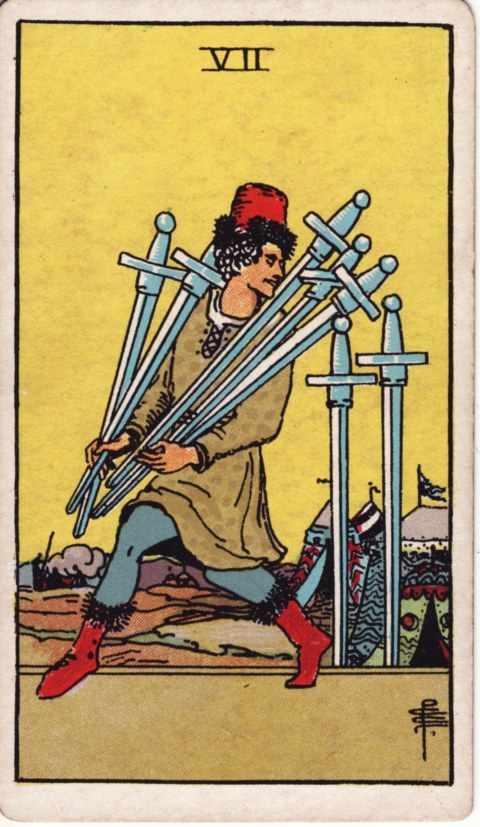
Is the Seven of Swords a thief, or a plan carried alone?
Look at what the man is doing. He carries away five swords, leaves two standing in the ground, and a camp lies right behind him. Waite writes that he is carrying them away "rapidly"; Pamela Colman Smith drew him on tiptoe, which is a different speed. Biddy Tarot gives the reading most sites repeat: "Traditionally, the Seven of Swords indicates theft, betrayal, deception and trickery." Waite's own list is milder: "Design, attempt, wish, hope, confidence." Both fit a person who has a plan and has told nobody. At work this week, write two lists, the tasks you will carry out yourself and the ones you are leaving behind on purpose, and show both to whoever signs off on the project.
Waite is careful with this card. He says "The design is uncertain in its import, because the significations are widely at variance with each other," and his list puts "hope" and "confidence" beside "a plan that may fail." Theft appears nowhere in it. In his later digest of meanings he calls it "a good card" that promises "a country life after a competence has been secured," which reads like a man who takes what he needs and then goes home; the thief is a modern layer over the picture.
Book T supplies the other half. Its meaning list opens with "Partial success," and it says the card yields "when victory is within grasp." The hands hold the swords so that the points "just touch" and the central sword does "not altogether" divide them. The old card is about getting nearly all of it and stopping. Its faults are mild ones too: "Inclined to betray confidences, not always intentionally." That describes a leaky mouth. Tarot.com asks the question that sorts the two readings: "Am I being smart, or am I just scared?"
Seven of Swords reversed: whose advice are you skipping?
Reversed, Waite gives "Good advice, counsel, instruction, slander, babbling," and his later digest adds a dry line: "Good advice, probably neglected." So the upside-down card is a conversation going on around you. Someone is telling you something useful, someone else is talking about you, and the two are mixed together. Labyrinthos and Biddy Tarot read the reversal as confession, self-deceit or secrets coming out, which is the modern layer. This week, take the one piece of advice from a manager or colleague that you nodded at and never used, and do its first step.
The words in Waite's list split in two. "Counsel" and "instruction" come from people who want you to do better. "Slander" and "babbling" come from people who just talk. A single reversed card can mean you are about to hear both. The way to tell them apart is to ask who gains if you act on what was said, and whether the speaker has anything to check it against.
Drawn alone, the card suggests an advice audit. Scroll back through your messages and notes for the last time you asked someone for advice, or were given it without asking. Write down what it was and whether you did it. If you find a piece you skipped, that is the advice the card means, and the step is small: ten minutes on it, or one follow-up question to the person who gave it. If you find nothing, look at the other side of the list and ask one trusted person what is being said about you, then compare it with what you can verify.
If you are asking whether someone is lying to you, cheating or about to leave, the card catches nobody. It describes quiet moves around you and your part in them. What another person did is a matter of facts, such as dates, messages and a direct conversation, and a card cannot supply them.
Is the Seven of Swords a yes or no card?
| Position | Answer |
|---|---|
| Upright | No, if it needs hiding |
| Reversed | Yes, once the advice is taken |
Upright, the Seven of Swords is a no whenever the plan only works while nobody knows about it, and a cautious yes if you could explain it aloud to the people it touches. Tarot.com is blunter: "the answer is NO." Ask whether to quit a job quietly, hide a number from a partner or take a shortcut that needs luck, and the card says no. Ask whether to work on a project alone for a week before presenting it, and the card allows that.
Reversed, we take it as a yes once the advice is taken. Waite's "Good advice, counsel, instruction" is the hopeful half, and "probably neglected" is the catch. Neither old source gives a verdict for any card; both answers here are modern practice.
Seven of Swords in love and friendship: cheating, single, feelings
With a partner
Inside a couple, the Seven of Swords points to something held back: a plan not yet shared or a decision made alone. The picture supports a modest claim, that someone is acting without telling. Cheating is one thing that could be, and a surprise party, a job application and a private fear are others. Ask the plain question aloud.
Single
Single, the card often describes your own caution. You keep your profile vague and leave two exits open. That can be sensible self-protection or a habit of never being fully there. Count how many people have heard what you actually want. If the answer is none, that is the bundle of five swords you are carrying.
As feelings
Taken as what someone feels, the card portrays someone careful with what they reveal. They may be interested and holding back, or unsure and saying nothing. Book T's portrait is someone "Inclined to betray confidences, not always intentionally," which suggests reserve that slips. The card shows how guarded they are and is silent on whether they will open up.
A secret between friends: told, kept, passed on
A quiet move that nobody has been told about: that is the Seven of Swords. With friends it is often a secret, either one you were trusted with or one you are keeping from them. Book T's person is "Inclined to betray confidences, not always intentionally," and that fits a slip better than a plot.
Reversed, Waite has good advice that is probably ignored, mixed with talk. Before you repeat what you heard about a friend, ask who gains. If you are carrying something you have hidden from a friend, tell them yourself this week, before someone else does.
Reversed in love
Reversed in love, Waite's "Good advice" suggests that a friend or relative has said something about the relationship worth hearing, and his "slander" suggests that part of what circulates about it is only talk. Sort one from the other before you act. If you are the one holding something back, saying it yourself, early and plainly, costs less than being found out.
Seven of Swords at work and with money
At work the upright card suits a project handled alone and out of sight: drafting before the meeting or fixing a problem quietly. Waite's "attempt" and "design" fit that. The risk is on Book T's list of faults, which includes the urge "to spy upon others," and at work that looks like watching colleagues' moves instead of making your own.
With money, the useful image is the two swords left in the ground. Count what you are leaving unprotected, such as a contract clause or a shared account, while you carry off the rest. Book T's "Partial success" warns that you may get most of it and not all. If you suspect fraud or theft, the card cannot confirm it. Bank statements can, and a lawyer if needed.
Reversed, an accountant, mentor or manager is offering advice you need before the deadline, so ask for the meeting. Office talk that sounds like Waite's "babbling" should be checked before it is repeated.
Seven of Swords as advice and as a person
Make the plan, then show it to one person. Taking five swords is reasonable when the camp is yours to leave, and it turns to trouble when nobody knows you took them. Say the plan aloud to someone who can object, and write down the two things you are leaving behind and why.
Drawn as a person, this card works alone and carefully. Picture a junior accountant named Lena (our invention) who finds an error in last quarter's figures and corrects it quietly before anyone sees. She did good work and she is the only one who knows. The card asks whether she tells her manager before the audit does. Book T warns of the type's other side, "Rather vacillatory and unreliable." Reversed as advice: choose one adviser and act on one thing they said this month.
How to read the Seven of Swords in a spread
Alone, the Seven of Swords says you have a plan that has not been said aloud, or someone near you does. Ask what it would sound like if you said it to everyone it touches. Across three positions, the past slot is a decision made quietly that still shapes things, the present slot is a plan under way, and the outcome slot is a partial win with something left behind.
The dignity rule in Book T reads "Swords are friendly with Cups and Wands." Beside it, a Cup softens the secrecy into tact or a private feeling, and a Wand pushes the plan into action. Another Sword makes the card sharper, with more talk and more scheming, and a Pentacle puts money or property at the center. Next to the Six of Swords, whose Book T title is "Earned Success," the effort has paid and the question is what comes with it. Next to The Star, the Major Arcana card of Aquarius, the plan carries hope.
The Seven of Swords among the Swords
Three Swords in a row share Aquarius. Book T puts the Five (Defeat, Venus), the Six (Earned Success, Mercury) and the Seven (Unstable Effort, Moon) there. The Seven follows a loss and a hard-won success and brings in the Moon, the body that changes its face every night. Read in order, that runs from defeat to success after trouble to success that does not hold. The sequence is an editorial reading; Book T lists the three cards side by side without telling a story.
The suit's rose gives the Seven a second link. The Three of Swords page tells how the rose was cut and later brought back. In the Seven, the hand that holds the central sword also holds the rose up, "as if the victory were at its disposal."
- Ace of Swords
- Two of Swords · Peace Restored
- Three of Swords · Sorrow
- Four of Swords · Rest from Strife
- Five of Swords · Defeat
- Six of Swords · Earned Success
- Seven of Swords · Unstable Effort
- Eight of Swords · Shortened Force
- Nine of Swords · Despair and Cruelty
- Ten of Swords · Ruin
- Page of Swords
- Knight of Swords
- Queen of Swords
- King of Swords
Titles after the numbered cards are the Golden Dawn's names for them in Book T.
Symbolism of the Rider–Waite–Smith card
- The tiptoeing figure. A slim figure in a red cap and red shoes strides forward on tiptoe and looks back over his shoulder. Waite gives him no face. The sidelong glance and the sly look are Smith's, and they turn a bare "carrying away" into someone checking whether anyone saw.
- Five swords in his arms. He holds them in an awkward bundle against his body, the blades overlapping. Waite counts them: "five swords." Five carried against seven in all is the picture of Book T's "Partial success," a gain that is real and incomplete.
- Two swords left standing. Two blades remain by the tents, planted tip-first in the earth, and Waite words it as "stuck in the ground." They are the part of the plan he did not take, or could not. The picture invites a question: what are you leaving upright behind you?
- The camp. Striped and patterned tents in red, blue and green stand close by, with a pennant on a pole. Waite's line is "A camp is close at hand." The distance he has covered is small. Whatever he took is still within earshot of the people he took it from.
- The flat yellow sky. The sky is flat yellow with no cloud and no night to hide in. As an editorial reading, the empty bright sky says this plan has nowhere to hide, which fits a card Waite himself calls uncertain.
What the oldest sources say
“Design, attempt, wish, hope, confidence; also quarrelling, a plan that may fail, annoyance. The design is uncertain in its import, because the significations are widely at variance with each other. Reversed: Good advice, counsel, instruction, slander, babbling.”
“Dark girl; a good card; it promises a country life after a competence has been secured. Reversed: Good advice, probably neglected.”
“Partial success. Yielding when victory is within grasp, as if the last reserves of strength were used up. Inclination to lose when on the point of gaining, through not continuing the effort. Love of abundance, fascinated by display, given to compliments, affronts and insolences, and to spy upon others. Inclined to betray confidences, not always intentionally. Rather vacillatory and unreliable.”
Waite gives this card two lists. The first opens hopeful, with "Design, attempt, wish, hope, confidence," then turns to "quarrelling, a plan that may fail, annoyance," and he admits the meaning is split. The second, in the digest of additional meanings, begins "Dark girl," a cartomancer's habit of tying cards to looks, which we leave aside, and then gives the surprising "a good card." The reversed line there, "Good advice, probably neglected," is the only place either list is dry.
In Book T the card is "The Lord of Unstable Effort" and sits on Netzach with a short label that says "in character untrustworthy." The meaning list describes nerve failing near the end, "Yielding when victory is within grasp," combined with vanity and a loose tongue. A thief is not on the list. Book T's picture has no man at all, only three hands and seven swords, so the camp, the red cap and the sidelong glance all come from Smith.
Seven of Swords and Moon in Aquarius: the card's decan
| Suit and element | Swords, Air (Major Arcana card of air: The Fool) |
|---|---|
| Decan | 20° to 30° ♒︎ Aquarius, the third ten degrees of the sign |
| Planet of the decan | Moon (Major Arcana: The High Priestess) |
| Major Arcana card of Aquarius | The Star |
| Golden Dawn title | The Lord of Unstable Effort |
| Place on the Tree of Life | Netzach (Book T: “Journey by land: in character untrustworthy”) |
Attributions from Book T (Golden Dawn, c. 1892; printed 1912).
In Book T the Seven of Swords rules the last decan of Aquarius, 20° to 30°, and its planet is the Moon: "Symbols of Moon and Aquarius." Aquarius belongs to air, the element of the suit. The trumps linked to this decan are The Star for Aquarius, The High Priestess for the Moon and The Fool for air.
The Moon changes shape every night, which suits a card titled Unstable Effort. That link is an editorial reading; Book T gives only the planet and the sign, with nothing more about why. The decan sits inside the Knight of Cups zone, which Book T draws from 20° of Aquarius to 20° of Pisces, so the two pages cover overlapping sky.
When the Sun is in the Seven of Swords stretch
| Year | Sun enters 20° | Sun leaves (reaches 30° Aquarius) |
|---|---|---|
| 2026 | Feb 8 | Feb 18 |
| 2027 | Feb 8 | Feb 18 |
| 2028 | Feb 9 | Feb 18 |
| 2029 | Feb 8 | Feb 18 |
This year the Sun crossed the Seven of Swords stretch of the zodiac (20° to 30° Aquarius) from February 8 to February 18, 2026. Next time: February 8 to February 18, 2027 (US Eastern dates).
Dates are US Eastern, from the astronomy-engine ephemeris. Across 35,064 dates from 1930 to 2025, the Sun is in this stretch on 2.7% of them, and at least one of the ten planets is on 23.1%.
By our ephemeris, this slice holds none of the five slow planets today. Saturn was here from March 2022 to March 2023, with a break, Neptune from 2007 to early 2012 and Uranus from 2000 to the end of 2003. Pluto first reaches it in March 2036 and stays, with breaks, until January 2044. Planet positions like these forecast no event.
Is the Seven of Swords in your birth chart?
Enter your birth date. We show which of the ten planets stood between 20° and 30° Aquarius that day, the slice of sky Book T gives this card; add the time if a planet was near the edge.
Enter your birth date above to see your result.
Every planet, angle and house from your birth time: birth chart calculator.
Questions about the Seven of Swords
Is the Seven of Swords a bad card?
Modern guides often call it sneaky. Waite does not: his main list opens with "hope" and "confidence," and his digest calls it "a good card." Book T reads it as partial success. It is a card of an unfinished plan.
Does the Seven of Swords mean someone is cheating?
It can point to something being held back, but it cannot show what or by whom. The card describes a situation and your own state. Facts, messages and a direct talk can show what another person did, and a card cannot.
What does the Seven of Swords mean as feelings?
Guardedness. The person is careful about what they show, whether from interest, doubt or habit. Reversed, someone may be offering them advice about you, or talk about the two of you is circulating.
Is the Seven of Swords yes or no?
Mostly no while the plan needs hiding; a cautious yes if you could say it aloud. Reversed, yes once the advice is taken. These are modern answers; the old texts give none.
What does the Seven of Swords reversed mean?
In Waite, "Good advice, counsel, instruction, slander, babbling," and in his digest "Good advice, probably neglected." Modern sites add confession and exposure.
Which sign holds the Seven of Swords?
Aquarius, its last ten degrees (20° to 30°), under the Moon by Book T. The Sun sits in that slice from about February 8 to 18.
When will the plan come out?
A card sets no dates. The Sun crosses these degrees from February 8 to 18; use that window as a convention if you like a calendar.
Sources
- Astronomy Engine: the open-source ephemeris library behind our planet positions, dates and statistics
- A. E. Waite, The Pictorial Key to the Tarot (1911), Wikisource: the divinatory meanings we quote, upright and reversed
- Book T (Golden Dawn), as printed in The Equinox I:8, 1912: the zodiac sign, Hebrew letter, title and short meaning of each card
- Wikimedia Commons: Rider–Waite–Smith tarot deck: Pamela Colman Smith's 1910 card drawings, public domain
- How we create our readings: our own calculation of sign dates, positions and the 1930 to 2025 statistics
Next to the Seven of Swords
In the suit of Swords: Six of Swords ← Seven of Swords → Eight of Swords.
Aquarius on this site: Aquarius zodiac sign · The Star, the card of Aquarius · your full birth chart.
All 22 Major Arcana with their signs and planets, and the minor cards written so far: tarot card meanings.
Written by The Zodiac Atlas editorial team with the help of AI and edited by a person. Quotations are from Waite's Pictorial Key to the Tarot and the Golden Dawn's Book T, both in the public domain; the card picture is a 1910 printing of Pamela Colman Smith's drawing for the 1909 deck. Sun dates and planet positions come from the astronomy-engine ephemeris (tropical zodiac). Tarot and astrology are symbolic traditions; they do not predict events.