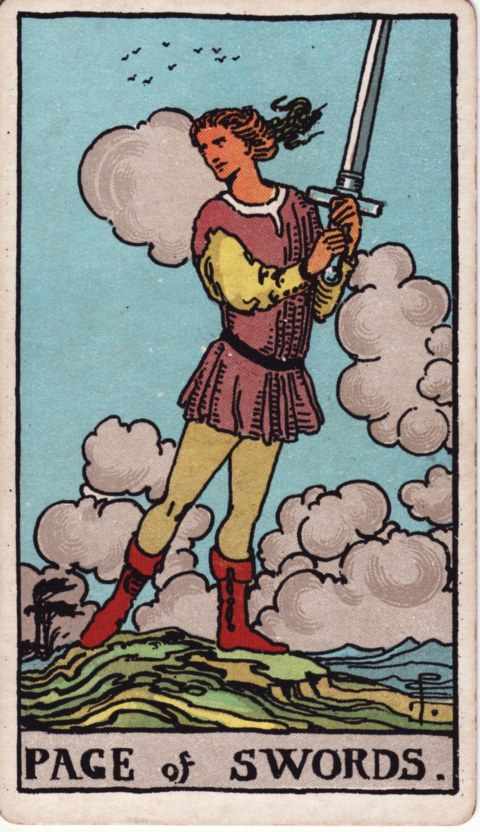
Page of Swords upright: curious or just nosy?
Waite's Page is a watcher before anything else: "looking this way and that, as if an expected enemy might appear at any moment." His list follows the stance, with "Authority, overseeing, secret service, vigilance, spying, examination." That is a sentinel, and nothing about her is relaxed. The modern pages soften the same figure into a student. Tarot.com calls the Page "the Tarot's student journalist, always asking questions, reading between the lines," and Labyrinthos lists curious, witty, chatty and vigilant among the upright keywords.
Put together, the card suits a stage when you need to find out before you decide: reading the contract, checking a rumor, asking the second question. Biddy Tarot stresses the early stage of it, exploring and not yet mastering, so mistakes are expected. Tarot.com adds a rule worth keeping, "Stay curious, not combative."
The Page also carries news. Labyrinthos says her news comes in the suit's own kinds: gossip, legal matters and agreements. A message or a document is on its way, and it may be sharper than you expected. Waite gives the reversed card "Astonishing news," so surprise is on the table either way.
Page of Swords reversed: is it gossip, spying or talk?
Reversed, the Page shows up in three forms. The first is talk with no weight behind it: Biddy Tarot gives "all talk and no action" and warns against promises you know you cannot keep. The second is prying and gossip, which Tarot.com describes as someone "watching, questioning, or snooping." The third is the sharp edge, which Labyrinthos puts as insults and rudeness, a gift for language turned into a weapon.
Waite's reversed list says the same in his dry way: "More evil side of these qualities; what is unforeseen, unprepared state; sickness is also intimated." The qualities are watching and examining, so the evil side is surveillance and suspicion. "Unprepared" fits someone who started speaking before checking. The word about sickness is a period flourish, and a card cannot say anything about your health. A physician can.
With a pen and one card, try this: write the thing you were about to say, post or pass on. Then write two lines under it, "I know this because ..." and "I would say it to their face because ..." If both fill in easily, you are speaking as an upright Page would, whatever side up the card fell. If the first line says "someone told me" or "I saw a post," you hold a rumor. If the second line stalls, you are about to use a sword at a distance. Check the source or keep the sentence in your notes.
People bring this card up when they suspect they are being watched, or talked about. Waite's other list offers "An indiscreet person will pry into the Querent's secrets," and the card can fit an actual snoop. Without more, it describes the habit of watching and talking, and it cannot read a named person's messages, plans or motives. Ask them, or leave it.
Is the Page of Swords a yes or no card?
| Position | Answer |
|---|---|
| Upright | Yes, check facts first |
| Reversed | Not yet |
Upright, yes, on a condition. Tarot.com answers YES and credits the card with insistence and mental rigor. It suits questions about asking, researching or applying. Check the facts first, since the Page is quick and still learning.
Reversed, wait. Something in the question depends on a rumor, a half-read document or a reply that has not come. Old sources never rule yes or no on a Page, so this verdict is modern practice.
Page of Swords as feelings, in love and with friends
In a relationship
With a partner the Page brings talk: questions, a long text thread, an overdue conversation, or a small dispute carried on in words. Labyrinthos notes a relationship that is more of the head than the heart, perhaps shy of emotional intimacy. Tarot.com has the plain advice, "You're here to connect, not interrogate." Ask what you want to know and listen to the answer with a level tone.
Single
Single, the card describes quick conversation and curiosity: a new person who asks a lot, texts late into the night, tests wit against wit. Tarot.com adds that there may be plenty of curiosity and not much depth yet. Enjoy the talk and notice whether they ever tell you something about themselves that cost them anything to say.
As feelings
As feelings, the Page means interest that sits in the head: they are curious about you, they analyze, they watch. Labyrinthos reads them as drawn to your mind while still checking whether their thoughts align with their emotions. That is early interest with caution built in. It promises nothing and refuses nothing, and what they do over a few weeks will tell you more than a card.
A new friend who asks a lot of questions
A new friend texts at midnight and asks about your family, your exes and your job, and you cannot tell interest from inspection. The Page of Swords is curious and quick. Waite draws him "looking this way and that", alert and not yet warm. Early on that is normal, since the head arrives before the heart.
Reversed, the questions turn into prying, or what you said gets repeated to someone else. Watch what they offer about themselves in return. Give one personal question a small true answer, then ask them one back and see whether it is met.
Reversed in love
Upside down, in a love question, she can mean prying, checking a partner's phone, repeating something told in trust, or a stream of sarcasm. Labyrinthos lists an argumentative or defensive partner and failed communication. If you are the one watching, ask whether it rests on something seen or only a feeling. If you are watched, say plainly what you will and will not share.
Page of Swords at work and with money
On the job, the Page is the new hire, the intern, the researcher, the person who asks the question nobody else dared. Labyrinthos reads her as an apprenticeship or the start of a job or course, and Tarot.com says job-hunting is a good time, since research skills are an advantage now. Money follows information: compare prices, read the terms, learn how the instrument works before putting anything into it.
Reversed at work, the card is office gossip, plans that are all talk, or an email sent before the facts were checked. Labyrinthos adds job-hopping and big ideas with zero follow-through. Stop passing things on and finish one task; put figures on any money idea before you tell anyone about it.
Page of Swords as advice and as a person
As advice, find out first. Ask the question, read the document, look up the source, and hold your opinion for a day. Tarot.com puts it as asking better questions. Then speak, once the answer is checked.
Read as a person, she is someone young, new or new to the matter, quick and very alert. Picture an intern named Priya who reads every attachment, spots that two dates in a contract disagree and raises it politely before anyone signs. Reversed as advice: hold back what you have not verified. Do not use what you know as leverage, and do not look through other people's things.
How to read the Page of Swords in a spread
With one card, the Page says you need more information than you have, so ask or look something up before you decide. Looking back, she marks a rumor, a message or a question that started the matter. In the present it describes your watchfulness or someone watching you. In an outcome position it points to news still to be checked.
Under Book T's dignity rules Swords get on with Cups and Wands, and Wands with Pentacles. Wands beside the Page give her energy to act on what she learns. Cups add feeling to her curiosity. Pentacles make the matter practical, and Book T's "Swords are inimical to Pentacles" is a reminder that facts and money do not always agree. As a reading, not a Book T rule: the Knight of Swords next to her can suggest an answer that arrives fast, and the Moon a story with a hidden side.
The Page of Swords among the Swords
In Swords the Page is where the suit begins as a person: a watcher on a hill, sword up, not yet in a fight. After her comes the Knight, who charges into the wind, then the Queen and the King, who judge. They run in order of age and weight, and the same sword grows from a question to a ruling.
The Page also stands next to the Ten of Swords, the end of the numbered cards. In the deck's order the Ten, face down under ten blades, is followed by a young figure on her feet with one blade held upright. It suggests that after the worst, a mind can start asking questions again.
- Ace of Swords
- Two of Swords · Peace Restored
- Three of Swords · Sorrow
- Four of Swords · Rest from Strife
- Five of Swords · Defeat
- Six of Swords · Earned Success
- Seven of Swords · Unstable Effort
- Eight of Swords · Shortened Force
- Nine of Swords · Despair and Cruelty
- Ten of Swords · Ruin
- Page of Swords
- Knight of Swords
- Queen of Swords
- King of Swords
Titles after the numbered cards are the Golden Dawn's names for them in Book T.
Symbolism of the Rider–Waite–Smith card
- The upright sword. She holds the blade upright in both hands and the tip leans to the upper right. Waite's picture text has her "in the act of swift walking." The sword is raised but not swung, which is the stance of readiness and watching.
- The sideways glance. The body leans one way while the head turns another. Biddy Tarot reads this as a look to see what else is going on around her. It is the vigilance of Waite's list: eyes on more than one thing.
- Wind and clouds. Her hair blows to one side, and the clouds are heaped up behind her. Swords belong to air, and the weather shows a mind in motion. Waite writes of clouds "collocated wildly."
- The flock of birds. A loose flock of small birds flies across the upper left of the sky. The old texts leave them out. Our reading is that they are thoughts in the air, many and quick, which fits the suit.
- High ground and distant water. She stands on a ridge of grass and rock, with pale hills and a strip of water far behind. Waite calls it "rugged land." From there she can see a long way, and the stance suits a lookout.
What the oldest sources say
“Authority, overseeing, secret service, vigilance, spying, examination, and the qualities thereto belonging. Reversed: More evil side of these qualities; what is unforeseen, unprepared state; sickness is also intimated.”
“An indiscreet person will pry into the Querent's secrets. Reversed: Astonishing news.”
Waite draws a watcher, and his two lists argue. The main list is full of the language of surveillance: "overseeing, secret service, vigilance, spying, examination." The short §4 list gives "An indiscreet person will pry into the Querent's secrets" upright and "Astonishing news" reversed, and this pair is where the modern gossip-and-news Page comes from. Most blogs tone the "spying" down to curiosity. The old list does not: this is a sentinel, and a sentinel can also be an informer.
Book T draws a different figure. "An AMAZON figure with waving hair," it says, "a mixture of Minerva and Diana," with "the head of the Medusa with serpent hair" for a crest, and her free hand resting on "a small silver altar with grey smoke (no fire) ascending from it." Her qualities are "Wisdom, strength, acuteness; subtlety in material things: grace and dexterity," and ill dignified she is "frivolous and cunning." Book T calls the Princesses "a Queen of Queens --- an Empress," and its warning is "Woe unto whomsoever shall make war upon her." That is far from a young beginner. The Equinox printing also ends her block with "Throne of the Ace of Wands," which is almost certainly a misprint for Swords, since the general section says the Princesses are thrones of the Aces of their own suits.
Page of Swords and Air
| Suit and element | Swords, Air (Major Arcana card of air: The Fool) |
|---|
Attributions from Book T (Golden Dawn, c. 1892; printed 1912).
Book T gives the numbered Swords a decan each and gives the Pages no slice of the zodiac. Her card reads "Earth of Air": the earth part of the air element. The Princess is the practical, grounded side of thought, the idea tested on the ground. Her Major Arcana match is The Fool, the card of the element air, and Waite's Page, young and watchful at the start of the road, suits it.
Book T sets the Princesses "above the respective Cherubic Signs of the Zodiac." For the Page of Swords it adds "a quadrant of the heavens around Kether." If "Cherubic Signs" means the four fixed signs, as we assume, the sign over her is Aquarius, the Water-Bearer, and a sign of air like the suit.
The suit of Swords is air, which in the old teaching is mind and speech. The Page is the youngest of its four court cards, the one who has the instrument and little experience of using it. Whatever is said about the card, the element is the part that stays constant, and it is the reason the same question can be answered either with a fact or with a rumor.
Questions about the Page of Swords
Is the Page of Swords a positive card?
Neither good nor bad on its own. It is a card of curiosity and watching, and Tarot.com answers YES. Waite's list also includes "spying," so it turns bad when attention turns into prying.
What does the Page of Swords mean as feelings?
Interest that lives in the head: they are curious, they ask questions and they analyze. Reversed, they are unsure, send mixed signals, or talk without following through.
Which person does the Page of Swords describe?
A young, sharp, talkative person, or someone new to a field and eager to learn. Waite's list suggests a watchful type. Book T has an Amazon, "a mixture of Minerva and Diana." Reversed, a gossip or someone who pries.
Does the Page of Swords mean someone is spying on me?
It can fit Waite's "An indiscreet person will pry into the Querent's secrets." It cannot tell you who, or whether it is true. If you suspect it, change what you share and ask the person directly.
Is the Page of Swords yes or no?
Yes once you have verified; Tarot.com agrees. Reversed, wait. The old sources give the Page no yes or no, so that rule comes from modern practice.
Which zodiac sign goes with the Page of Swords?
None by Book T, which gives Pages no slice of the zodiac. The element is air, and if you read the fixed signs into its text, Aquarius is the closest match.
How long until the news from the Page of Swords arrives?
The card carries no dates. Waite reads the Page as a bearer of news, and the timing is left open. While you wait on a reply, a short follow-up does more than a card.
Sources
- Astronomy Engine: the open-source ephemeris library behind our planet positions, dates and statistics
- A. E. Waite, The Pictorial Key to the Tarot (1911), Wikisource: the divinatory meanings we quote, upright and reversed
- Book T (Golden Dawn), as printed in The Equinox I:8, 1912: the zodiac sign, Hebrew letter, title and short meaning of each card
- Wikimedia Commons: Rider–Waite–Smith tarot deck: Pamela Colman Smith's 1910 card drawings, public domain
- How we create our readings: our own calculation of sign dates, positions and the 1930 to 2025 statistics
Next to the Page of Swords
In the suit of Swords: Ten of Swords ← Page of Swords → Knight of Swords.
All 22 Major Arcana with their signs and planets, and the minor cards written so far: tarot card meanings.
Written by The Zodiac Atlas editorial team with the help of AI and edited by a person. Quotations are from Waite's Pictorial Key to the Tarot and the Golden Dawn's Book T, both in the public domain; the card picture is a 1910 printing of Pamela Colman Smith's drawing for the 1909 deck. Sun dates and planet positions come from the astronomy-engine ephemeris (tropical zodiac). Tarot and astrology are symbolic traditions; they do not predict events.