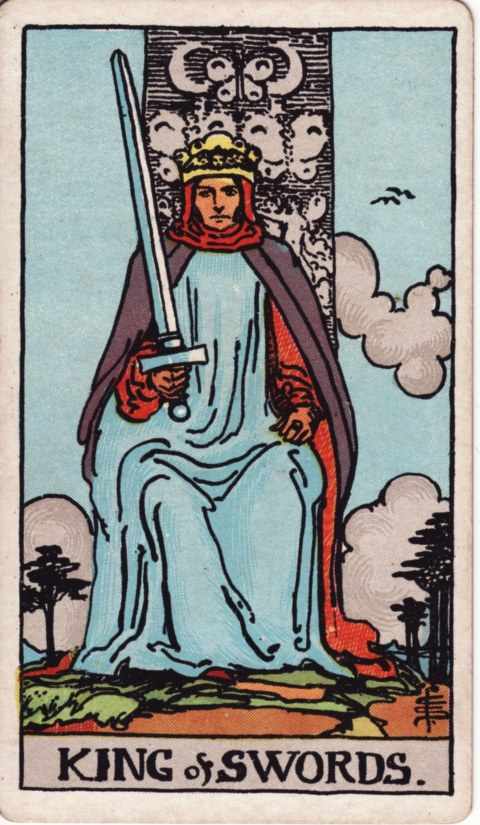
King of Swords meaning: what does the judge-king say?
Yes, it is a good card, and it comes with a price: the King of Swords gives you the truth before he gives you comfort. Waite begins his list with "Whatsoever arises out of the idea of judgment" and carries on through command, law and "offices of the crown." Nothing in that list is warm. This is the officer who reads the evidence before he reads the room, which makes him a good draw when you need a decision that will still stand next year.
Think of a judge who rules against an old friend because the contract says so, or a doctor who states the numbers before the reassurance. Waite's later list names the same people: "A lawyer, senator, doctor." If the card stands for someone in your life, expect precision, a long memory for promises and very little small talk. If it stands for you, it asks for the plain version of the facts, written down, with your preferences listed on a separate line.
Biddy Tarot adds a useful detail about the advisor version of this king: he "may come across as detached or disinterested in your personal circumstances," because he keeps only what bears on the question. An answer that sounds cold and is correct serves you better than a warm one that is wrong.
Is the reversed King of Swords cold, cruel or just stuck?
Waite's reversed list is blunt: "Cruelty, perversity, barbarity, perfidy, evil intention." His later list is shorter and more practical: "A bad man; also a caution to put an end to a ruinous lawsuit." Labyrinthos puts the modern version as "tyrannical, abusive and manipulative habits," while Biddy Tarot offers a gentler turn, "quiet power," where authority comes from inside a person, whatever the title.
Drawn alone, the reversal can point two ways, and the picture helps sort them. In one, somebody uses rules as a weapon: precise, correct and merciless. In the other, the ruling is held back, either because the judge fears being judged in turn or because the facts are still thin. Which applies depends on who pays when the king finally speaks.
A test you can run today: write the verdict in question as one sentence, then swap the roles. Imagine the same rule applied to you, by the same person, on the same facts. If you would call that fair, the king is upright in practice and the card is only reversed on the table. If you would call it a setup, you are looking at power used for its own sake, whoever happens to be holding the sword.
Asking whether a case, an appeal or a refund will go your way? The card shows how judgment is being used around you and gives no court decision or date. Waite's phrase about ending "a ruinous lawsuit" is a caution about cost, and cost can be checked: put the best realistic outcome next to the total spent so far, then ask a licensed lawyer for an honest estimate. If the question is about an ex, the card speaks of the standard each of you now holds, and promises no return.
Is the King of Swords a yes or no card?
| Position | Answer |
|---|---|
| Upright | Yes, if the facts back it |
| Reversed | Not yet, or no if it is unfair |
Drawn upright, the King of Swords counts as a yes when the facts are on your side and you can give the reason in one sentence. Tarot.com is blunter: for this card "the answer is YES." The yes comes with homework, because this is the king who wants to see the paperwork.
Reversed, it is a no for now: the evidence is incomplete, the person deciding is not neutral, or the choice is being used as a weapon. Yes and no are modern additions; Waite and Book T attach to the card only the meanings quoted on this page.
King of Swords in love and friendship: what does he feel and how does he show it?
Together: the partner who keeps agreements
In a couple the king shows a relationship run on clear terms: who does what, what was promised, what happens when someone is late. It suits partners who like clarity and can be hard on one who wants constant reassurance. Tarot.com adds a caution worth keeping: "Love isn't a debate to be won." The test of the card is whether you can lose an argument well and still be at the same table by dinner.
Single: the careful one
For someone single, the king often points to a person you have to be patient with: reserved, well-read, loyal once decided, slow to say what they feel. Book T describes him as "distrustful, suspicious, firm in friendship and enmity," which in dating means trust arrives late and stays long. The card can equally describe a standard you set for yourself, with no more people who are charming and unclear.
As feelings: respect that shows in conduct
As feelings, expect respect, loyalty and a preference for acting over declaring. This person shows interest by remembering details, keeping appointments and telling you the truth when it is awkward. The gap is that none of it sounds romantic. If you need the words you will have to ask, and the answer may be an argument where you hoped for a poem.
Should you lend a friend money?
A friend asks for $400 until the first of the month. The King of Swords stands for clear terms, and Book T calls him "firm in friendship and enmity". Be generous or say no, but agree on the amount and the date out loud before the transfer. Vagueness does more harm than the debt.
Reversed, he becomes the judge or the silent creditor who keeps a tally and brings it up in an unrelated argument. Check which one you are. If the money is already out, text once and ask for a date, and skip the hints.
Reversed in love: the prosecutor and the silent treatment
Reversed in love, the card can describe a partner who keeps score, argues like a prosecutor, or goes quiet as a punishment. It can also describe you, holding a decision about the relationship that you have made in your head and never said aloud. Either way the useful move is to state the standard ("this is what I need") in plain words before it starts working through silence.
King of Swords at work and with money
In an office he is the lawyer, auditor, editor, physician, judge or senior engineer whose sign-off makes a decision final. Waite's phrases "law" and "offices of the crown" read like a civil-service description, and that fits: this is authority that comes from a role and a code, and charm has little to do with it. For you the card advises putting your reasoning in writing and making the decision something your team can repeat to others without you in the room.
With money the card favors written terms, a budget checked against actual statements and advice from someone licensed. Advisers of this type cost real money and are worth it mostly when they are willing to say no. This is not financial or legal advice.
If the king lands reversed, look for the manager who rules by mood, the review that was settled before the evidence arrived, or your own decision left pending because you want it to be beyond criticism. With money, Waite's warning about a ruinous lawsuit applies: stop paying for a fight whose likely gain is smaller than its cost, and have a professional confirm the numbers.
King of Swords as advice and as a person
As advice the king says: write it down. State the question, the facts, the rule you are applying and the ruling, in that order, before you talk to anyone. If the ruling embarrasses you on paper, you have found the problem early and cheaply.
As a person, picture an invented compliance officer named Mirela in a hospital. A well-liked colleague has skipped a sign-off. She does not raise her voice. She shows him the log and explains what the rule protects, then offers a way to correct the record. He is irritated for a week and the ward is safer afterward.
As reversed advice, the card tells you to stop applying a rule only to people you dislike, or to stop postponing a ruling because it will be unpopular. Pick the smaller of the two evils and say it to the person's face.
How to read the King of Swords in a spread
Read by position, he stands in the past for a ruling or a rule behind your question. In the present he asks whether the matter is being judged fairly. As an outcome he points to a decision that can be defended, pleasant or not, and as the obstacle he is an authority or a standard standing in your way.
Neighbors change his tone. The dignity rules state "Swords are inimical to Pentacles." With a Pentacles card at his side, the ruling runs into money, property or comfort. The same list calls Swords "friendly with Cups and Wands," which suggests a Cups card puts feeling into the ruling and a Wands card supplies the energy to carry it out. Other Swords cards on either side strengthen him, for better or worse.
Beside Justice he is a near twin, and Waite himself notes that the king "recalls, of course, the conventional Symbol of Justice." Beside the Five of Swords he becomes the one who decides what counts as a defeat. Beside The Devil, Book T's card for Capricorn, he reads as rules that bind the person who wrote them.
The King of Swords among the Swords
The Swords court ends with the King, the only one of the four Book T labels "Air of Air." The Knight is fire acting through air, the Queen is water meeting air, and the King is air with nothing else mixed in: thought without heat or tide. That is a neat reason for the raised sword: he is the suit's judge.
Book T spreads the three Swords courts around the year: the Knight over 20° Taurus to 20° Gemini, the Queen over 20° Virgo to 20° Libra, the King over 20° Capricorn to 20° Aquarius. He alone holds the cold stretch from about January 10 to February 8. Waite calls him "the power of life and death, in virtue of his office," and a ruler who decides what ends has a fitting seat in the cold stretch of the northern year.
- Ace of Swords
- Two of Swords · Peace Restored
- Three of Swords · Sorrow
- Four of Swords · Rest from Strife
- Five of Swords · Defeat
- Six of Swords · Earned Success
- Seven of Swords · Unstable Effort
- Eight of Swords · Shortened Force
- Nine of Swords · Despair and Cruelty
- Ten of Swords · Ruin
- Page of Swords
- Knight of Swords
- Queen of Swords
- King of Swords
Titles after the numbered cards are the Golden Dawn's names for them in Book T.
Symbolism of the Rider–Waite–Smith card
- The upright sword. Waite writes that he is "holding the unsheathed sign of his suit." The blade points up, ready but not swinging. In our view that is authority at rest, which is also how a judge holds a gavel before a ruling.
- Butterfly and crescents on the throne. The tall throne is carved with a butterfly and crescent moons. Biddy Tarot ties the butterflies to transformation. The same motif turns up in Book T, where the chariot is drawn by "Arch Fays" with "butterfly wings," so the idea of a ruler who changes his mind when the facts change is old.
- Pale blue robe and violet cloak. He wears a pale blue robe under a violet cloak. Labyrinthos reads the blue as spiritual understanding. The colors are cool and calm, which suits a king whose temperature is meant to stay low.
- Clouds, dark trees, two birds. Behind him are clouds, dark trees and two birds in flight. Our reading: the weather belongs to the air suit, and he sits above it, high enough to see all of it at once.
- The king in Book T. In Book T he is a winged king riding in a chariot, a sword in one hand and a sickle in the other, with grey nimbus clouds underneath and whorls on his armor. The sickle is the part the modern card leaves out.
What the oldest sources say
“Whatsoever arises out of the idea of judgment and all its connexions—power, command, authority, militant intelligence, law, offices of the crown, and so forth. Reversed: Cruelty, perversity, barbarity, perfidy, evil intention.”
“A lawyer, senator, doctor. Reversed: A bad man; also a caution to put an end to a ruinous lawsuit.”
Waite's main list is nearly a job description: judgment, command, authority, "militant intelligence," law. The later list narrows it to three professions, "A lawyer, senator, doctor," and for the reversed card it turns practical: "A bad man; also a caution to put an end to a ruinous lawsuit." The two halves of that line sit oddly together, a verdict on a character and a piece of legal housekeeping. For a modern reader the lawsuit clause is the more useful, because it is advice you can act on, while "bad man" repeats the first list's "Cruelty, perversity."
Book T supplies the part that today's blogs lose. It calls him "Full of ideas and thoughts and designs" and in the same breath "distrustful, suspicious," "careful, observant, slow, over-cautious." Then comes the pair that gives this page its title: "With the sword he rules, with the sickle he slays," and "he slays as fast as he creates." So the old king is slow because every ruling cuts something off, and the sickle is as much a part of his office as the sword. The ill-dignified portrait is "harsh, malicious, plotting; obstinate, yet hesitating; unreliable," which is the reversed card with its hesitation left in.
King of Swords in the zodiac: Capricorn to Aquarius
| Suit and element | Swords, Air (Major Arcana card of air: The Fool) |
|---|---|
| Part of the zodiac | 20° Capricorn to 20° Aquarius |
| Book T | Air of Air |
Attributions from Book T (Golden Dawn, c. 1892; printed 1912).
The sky of the King of Swords is stated plainly in Book T: "Rules from 20 Degree Capricorn to 20 Degree Aquarius." Book T headlines him "The Prince of the Chariot of the Winds" and ends the entry on "Air of Air." The zone takes in the last decan of Capricorn, an earth sign, and the first two decans of Aquarius, an air sign. Book T's major card for Capricorn is The Devil, and the card for the element of air is The Fool.
Three numbered cards fall inside it, by our counting of Book T's decans: the Four of Pentacles (Lord of Earthly Power), the Five of Swords (Lord of Defeat) and the Six of Swords (Lord of Earned Success). The order fits a judge oddly well: possession first, then a loss, then a success that Book T calls earned, which echoes the sword-and-sickle line, where building and ending come from the same hand. The Sun passes through it between about January 10 and February 8.
When the Sun is in the King of Swords stretch
| Year | Sun enters 20° Capricorn | Sun leaves (reaches 20° Aquarius) |
|---|---|---|
| 2026 | Jan 10 | Feb 8 |
| 2027 | Jan 10 | Feb 8 |
| 2028 | Jan 10 | Feb 9 |
| 2029 | Jan 9 | Feb 8 |
This year the Sun crossed the King of Swords stretch of the zodiac (20° Capricorn to 20° Aquarius) from January 10 to February 8, 2026. Next time: January 10 to February 8, 2027 (US Eastern dates).
Dates are US Eastern, from the astronomy-engine ephemeris. Across 35,064 dates from 1930 to 2025, the Sun is in this stretch on 8.1% of them, and at least one of the ten planets is on 54.6%.
The slow planets add a calendar of their own. By our calculation Pluto stood in the zone from February to July 2018, has been there since December 2018, and leaves in March 2036, with one more stay from August 2036 to January 2037. Saturn crossed it from December 2019 to March 2022 and made a last pass from September to December 2022. A planet of endings and power structures in a king's zone is a coincidence of symbols that forecasts nothing, but it is a reason to read this card with long-term decisions in mind.
Is the King of Swords in your birth chart?
Enter your birth date. We show which of the ten planets stood between 20° Capricorn and 20° Aquarius that day, the slice of sky Book T gives this card; add the time if a planet was near the edge.
Enter your birth date above to see your result.
Every planet, angle and house from your birth time: birth chart calculator.
Questions about the King of Swords
Is the King of Swords a good card or a bad one?
Good when upright: a fair, exact judge who decides on facts. Reversed, Waite lists "Cruelty, perversity, barbarity, perfidy, evil intention," so the bad side is power used coldly. Book T adds that even the upright king is "slow, over-cautious."
Who is the King of Swords as a person?
A fair, exacting adult with authority, often a lawyer, judge, doctor or official. Waite's later list says "A lawyer, senator, doctor." The card can equally be you, at a moment when you must rule on something.
How does the King of Swords show feelings?
Respect, loyalty and honest speech, usually with few romantic words. This person shows care by keeping promises. Reversed, the feelings go cold, are held as leverage or come out only as criticism.
Is the King of Swords cold?
He can look cold, because he keeps feeling out of the verdict. That is detachment; cruelty belongs to the reversed card.
Does the King of Swords answer yes?
Upright he leans yes when the facts back the plan, and Tarot.com says so too. Reversed he is a not yet. These are modern answers; neither old source states one.
Does the King of Swords have a zodiac sign?
Two signs share him. Book T sets his zone at 20° Capricorn to 20° Aquarius and labels him "Air of Air." Sun dates: about January 10 to February 8.
Does the King of Swords say when?
No. For a calendar hook, use the Sun's passage through his stretch of sky, about January 10 to February 8; it is a convention and predicts nothing.
Sources
- Astronomy Engine: the open-source ephemeris library behind our planet positions, dates and statistics
- A. E. Waite, The Pictorial Key to the Tarot (1911), Wikisource: the divinatory meanings we quote, upright and reversed
- Book T (Golden Dawn), as printed in The Equinox I:8, 1912: the zodiac sign, Hebrew letter, title and short meaning of each card
- Wikimedia Commons: Rider–Waite–Smith tarot deck: Pamela Colman Smith's 1910 card drawings, public domain
- How we create our readings: our own calculation of sign dates, positions and the 1930 to 2025 statistics
Next to the King of Swords
In the suit of Swords: Queen of Swords ← King of Swords.
Capricorn on this site: Capricorn zodiac sign · The Devil, the card of Capricorn · your full birth chart.
All 22 Major Arcana with their signs and planets, and the minor cards written so far: tarot card meanings.
Written by The Zodiac Atlas editorial team with the help of AI and edited by a person. Quotations are from Waite's Pictorial Key to the Tarot and the Golden Dawn's Book T, both in the public domain; the card picture is a 1910 printing of Pamela Colman Smith's drawing for the 1909 deck. Sun dates and planet positions come from the astronomy-engine ephemeris (tropical zodiac). Tarot and astrology are symbolic traditions; they do not predict events.