What does the Three of Swords mean?
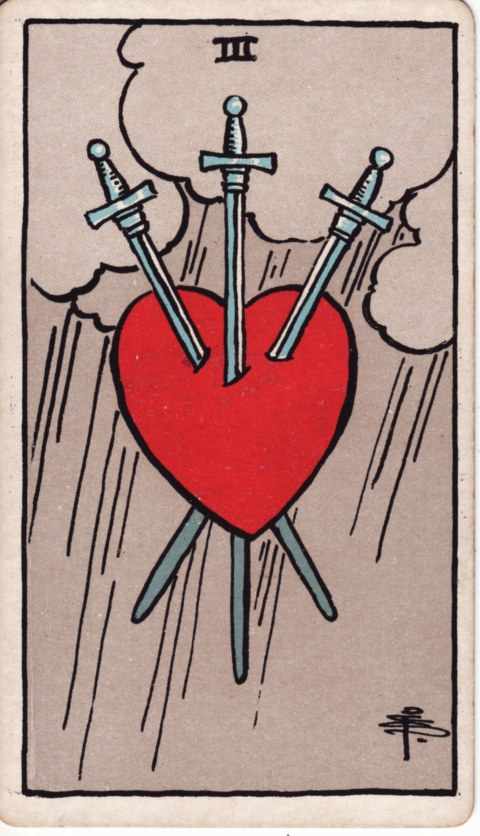
Upright, the card names a hurt that has already landed: a breakup, a betrayal, a loss, words you cannot take back. No figure on the card softens it. You see only the heart, the blades and the weather. Labyrinthos calls it "an image of grief, loss and literally heartbreak," and Biddy Tarot reads the swords as "the pain inflicted by words, actions and intent."
Waite's own list is wider than heartbreak. In The Pictorial Key to the Tarot he gives "Removal, absence, delay, division, rupture, dispersion," and adds that the rest is too obvious to spell out. Several of those words are about distance. Someone leaves, a plan stalls, a group breaks up. That reading helps when the question is about a move, a delay or a falling-out among friends.
Most modern readers also find a release in it. Tarot.com writes that the card "shows up when pain needs to be acknowledged, not avoided," and Biddy Tarot calls it "an emotional release." The upright advice is plain. Name what hurt and let yourself feel it. Do not rush to fix it that day.
Three of Swords reversed: healing or buried hurt?
Reversed, the Three of Swords goes one of two ways. In a spread, the cards around it decide which; in a one-card pull, the test at the end of this section does. In the first, the worst is over. Labyrinthos lists "healing, forgiveness, recovery, reconciliation" and says "all difficult moments pass." In the second, the pain is still there but out of sight. Tarot.com warns that buried hurt can show up "as irritability, numbness, even self-sabotage."
Biddy Tarot adds a third reading. It turns the reversed card toward "negative self-talk" and asks "whether you would ever utter these words to a friend or loved one." Read that way, the blades are your own words. Waite's reversed list points the same way, toward the mind rather than the heart: "Mental alienation, error, loss, distraction, disorder, confusion."
Here is a practical test. If you can talk about what happened without the old jolt, read the healing side. If you change the subject or feel nothing at all, read the buried side.
Asking whether an ex will come back? The reversed card does not say yes. Labyrinthos reads it in love as lovers "settling their conflicts and forgiving one another," and adds that sometimes "it can be better for both to move on." It describes the state of your wound. His plans are not on the card.
Is the Three of Swords a yes or no card?
| Position | Answer |
|---|---|
| Upright | No |
| Reversed | Not yet, healing comes first |
For a yes or no question the upright Three of Swords is a no. Tarot.com gives it a NO and calls it "a card of remembering old hurts." If you asked whether to text an ex, take the job with the difficult boss, or try once more with a friend who keeps letting you down, the card says the cost is already showing.
Reversed, we read it as not yet. The hurt is healing. A decision made from the middle of it is likely to repeat it. Waite and Book T give no yes or no values at all, so every answer here, ours included, is modern practice.
Three of Swords in love and friendship: relationship, single, feelings
In a relationship
In a couple the card points to a painful truth coming out, a fight that cut deep, or a separation. Labyrinthos notes that because this is a three, "it can also point to a third party creating trouble in your relationship." It does not prove an affair. Ask what was said or done, and whether both of you are willing to talk about it.
Single
When you are single, the card usually looks back. Tarot.com says "old wounds could be influencing how you connect or disconnect," and Labyrinthos advises giving yourself time before you look for love again. This card describes a date that keeps reminding you of the last person.
As feelings
As someone's feelings, the Three of Swords means hurt. They may feel betrayed or disappointed. The hurt may come from before you. Labyrinthos reads it as feelings "torn between their affection for you and the lingering pain." The card shows how they feel. It does not say whether they will act on it.
When your friend has a new best friend
Here the Three of Swords brings the sting of being left out: your friend has a closer friend now, and you find out from a photo. Labyrinthos says the number three "can also point to a third party creating trouble in your relationship." That names the shape of the hurt, though it does not say anyone did it on purpose.
Reversed, the sting is either fading or pushed down and turning sour. If you can think of the photo without the jolt, it is fading. This week, tell your friend once, without blame, that you missed them, and then let them answer.
Reversed in love
Reversed in a love reading, the card often means forgiveness after a rupture, or getting over a breakup enough to date again. Labyrinthos also warns of the opposite: hurt that is "repressed, so they fester and create resentment." If you are trying again with an ex, look at whether the old wound was talked through or just left alone.
Three of Swords at work and with money
At work the card points to a disappointment that stings: a lost job, a project that failed, a review that hurt, or office politics where "miscommunications may cut deep," as Tarot.com puts it. Labyrinthos reads the most common case as conflict with colleagues or clients. The advice is honest, respectful conversation.
With money, Labyrinthos ties the card to loss and to the cost of a breakup: you may no longer afford the apartment alone, or you may have to split your assets. Book T, oddly, lists "honesty in money transactions" among the meanings of this same card, so a money question here may concern a painful division done fairly.
Three of Swords as advice and as a person
As advice, the card is blunt. Let it hurt, then deal with it. Tarot.com puts it as "Let it hurt, but don't let it define you." In practice, tell one person what happened and write down the facts. Leave big decisions for a few days.
As a person, the Three of Swords describes someone in the middle of grief, or someone whose words cut more than they intended. Biddy Tarot reminds you that other people's hurtful words are "merely another person's opinion or a projection of their own inner fears."
How to read the Three of Swords in a spread
In a past position the card often marks the event a question grew out of: the breakup, the falling-out, the loss. In a present position it says the hurt is still active. In an outcome position, take it as a warning about the cost of the path you asked about.
Book T says a card is "strong or weak, well dignified or ill dignified, according to the cards next to it on either side," and that "Cards of the same suit on either side strengthen it greatly." Two more Swords beside it make the hurt louder. Cups beside it, which Book T calls friendly to Swords, soften it toward feeling and repair. Pentacles beside it weaken it, since Swords are "inimical to Pentacles," and the matter tends to be practical: money or a home after a split.
Next to the Four of Swords, which Book T calls Rest from Strife, we read rest after the blow. Next to the Five of Cups, the grief is about what was lost. Next to Justice, the card that Book T gives to Libra like this one, the hurt may come with a formal end: a divorce, a contract, a ruling.
The Three of Swords among the Swords
Book T draws the Three of Swords as the second part of a story. In the Two of Swords, two crossed blades hold a rose with five petals giving off white rays. In the Three, "the central sword cuts asunder the rose of five petals, which in the previous symbol grew at the junction of the swords; its petals are falling, and no white rays issue from it." In the Four, "The rose of five petals with white radiations is reinstated."
So in the Golden Dawn's own design the three cards run peace, rupture, recovery: Peace Restored, Sorrow, Rest from Strife. Pamela Colman Smith drew a heart where Book T has a rose, but the order is the same. It is a fair way to read the card: the Three is the middle of something.
- Ace of Swords
- Two of Swords · Peace Restored
- Three of Swords · Sorrow
- Four of Swords · Rest from Strife
- Five of Swords · Defeat
- Six of Swords · Earned Success
- Seven of Swords · Unstable Effort
- Eight of Swords · Shortened Force
- Nine of Swords · Despair and Cruelty
- Ten of Swords · Ruin
- Page of Swords
- Knight of Swords
- Queen of Swords
- King of Swords
Titles after the numbered cards are the Golden Dawn's names for them in Book T.
Symbolism of the Rider–Waite–Smith card
- The heart. A red heart floats alone in the sky. Labyrinthos calls the heart "the seat of warmth, affection and spirit." No person appears on the card, so the hurt reads as yours.
- Three swords. One blade goes straight down the middle and two cross it from the sides. Swords are the suit of air: thought and words. Biddy Tarot reads them as hurt done "by words, actions and intent."
- Clouds and rain. Grey clouds and slanting rain fill the background. Biddy Tarot reads the storm as passing: "just as the storm clouds will disappear, so too will the pain."
- The older model. Wikipedia lists this card among the notable similarities between Smith's deck and the Sola Busca tarot, the earliest 78-card deck that survives complete, and notes that some scholars think Smith drew inspiration from it.
What the oldest sources say
“Removal, absence, delay, division, rupture, dispersion, and all that the design signifies naturally, being too simple and obvious to call for specific enumeration. Reversed: Mental alienation, error, loss, distraction, disorder, confusion.”
“For a woman, the flight of her lover. Reversed: A meeting with one whom the Querent has compromised; also a nun.”
“Disruption, interruption, separation, quarrelling; sowing of discord and strife, mischief-making, sorrow and tears; yet mirth in Platonic pleasures; singing, faithfulness in promises, honesty in money transactions, selfish and dissipated, yet sometimes generous: deceitful in words and repetitions; the whole according to dignity.”
Waite wrote two lists for this card. The main one, quoted above, is about removal and division. In a later section of the same book, "Some additional meanings of the Lesser Arcana," he adds a shorter reading: "For a woman, the flight of her lover." The reversed line there ends with "also a nun." Both are about someone leaving.
Book T calls the card "The Lord of Sorrow" and gives a mixed list: "Disruption, interruption, separation, quarrelling; sowing of discord and strife, mischief-making, sorrow and tears; yet mirth in Platonic pleasures; singing, faithfulness in promises, honesty in money transactions," and it goes on from there. The good items in that list show that the Golden Dawn read every card by the cards around it. You should too.
Three of Swords and Saturn in Libra: the card's decan
| Suit and element | Swords, Air (Major Arcana card of air: The Fool) |
|---|---|
| Decan | 10° to 20° ♎︎ Libra, the second ten degrees of the sign |
| Planet of the decan | Saturn (Major Arcana: The World) |
| Major Arcana card of Libra | Justice |
| Golden Dawn title | The Lord of Sorrow |
| Place on the Tree of Life | Binah (Book T: “Unhappiness, sorrow, and tears”) |
Attributions from Book T (Golden Dawn, c. 1892; printed 1912).
In Book T each numbered card from 2 to 10 rules one decan, a ten-degree slice of a zodiac sign. The Three of Swords rules the second decan of Libra, which is 10° to 20° of the sign, and its planet is Saturn: "Above and below the central sword are the symbols of Saturn and Libra." Libra is an air sign, which fits the suit of air. Its Major Arcana card is Justice.
Traditional astrology counts Libra as the sign of Saturn's exaltation. There the planet is strong. The decan's grief has a hard edge of fairness to it, the sorrow of a rule applied or a line drawn. That link is our reading of the attribution, not a line from Book T.
When the Sun is in the Three of Swords stretch
| Year | Sun enters 10° | Sun leaves (reaches 20° Libra) |
|---|---|---|
| 2026 | Oct 3 | Oct 13 |
| 2027 | Oct 3 | Oct 13 |
| 2028 | Oct 2 | Oct 12 |
| 2029 | Oct 2 | Oct 12 |
This year the Sun crossed the Three of Swords stretch of the zodiac (10° to 20° Libra) from October 3 to October 13, 2026. Next time: October 3 to October 13, 2027 (US Eastern dates).
Dates are US Eastern, from the astronomy-engine ephemeris. Across 35,064 dates from 1930 to 2025, the Sun is in this stretch on 2.8% of them, and at least one of the ten planets is on 27.3%.
Saturn itself last crossed this decan in 2010 and 2011 and returns to it in 2039 to 2041, by our calculation. If your Sun falls between October 3 and October 13 in most years, the tool below will show the Three of Swords as your decan card. It is a minor arcana birthday card and describes a theme in the Golden Dawn system.
Is the Three of Swords in your birth chart?
Enter your birth date. We show which of the ten planets stood between 10° and 20° Libra that day, the slice of sky Book T gives this card; add the time if a planet was near the edge.
Enter your birth date above to see your result.
Every planet, angle and house from your birth time: birth chart calculator.
Questions about the Three of Swords
Is the Three of Swords a bad card?
It is one of the hardest cards in the deck, and Wikipedia lists it among the most negative. The pain it describes has already happened, and in Book T the card sits between Peace Restored and Rest from Strife.
Does the Three of Swords mean cheating?
It can. Labyrinthos notes that the three can point to a third party. It can just as well mean harsh words or a breakup with no one else involved, so read the cards next to it.
What does the Three of Swords mean as feelings?
Hurt. The person feels betrayed, disappointed or sad, sometimes because of something from before you. Reversed, they are starting to heal and open up.
Is the Three of Swords yes or no?
No when upright; Tarot.com gives it a NO too. Reversed we read it as not yet, because the hurt is still healing.
What zodiac sign is the Three of Swords?
Libra. Book T gives it the second decan of Libra, ruled by Saturn; in degrees that is 10° to 20° of the sign. The Sun passes through it from about October 3 to October 13.
Does the Three of Swords mean someone will die?
No reading can tell you that. Some modern guides list grief and loss among its meanings, and Waite's list is about removal, absence and division. Read it as loss of some kind.
What does the Three of Swords mean in a health reading?
Tarot is not medical advice. The card cannot tell you anything about your body. If the question comes from worry about your health, a doctor is the right person to ask.
Sources
- Astronomy Engine: the open-source ephemeris library behind our planet positions, dates and statistics
- A. E. Waite, The Pictorial Key to the Tarot (1911), Wikisource: the divinatory meanings we quote, upright and reversed
- Book T (Golden Dawn), as printed in The Equinox I:8, 1912: the zodiac sign, Hebrew letter, title and short meaning of each card
- Wikimedia Commons: Rider–Waite–Smith tarot deck: Pamela Colman Smith's 1910 card drawings, public domain
- How we create our readings: our own calculation of sign dates, positions and the 1930 to 2025 statistics
Next to the Three of Swords
In the suit of Swords: Two of Swords ← Three of Swords → Four of Swords.
Libra on this site: Libra zodiac sign · Justice, the card of Libra · your full birth chart.
All 22 Major Arcana with their signs and planets, and the minor cards written so far: tarot card meanings.
Written by The Zodiac Atlas editorial team with the help of AI and edited by a person. Quotations are from Waite's Pictorial Key to the Tarot and the Golden Dawn's Book T, both in the public domain; the card picture is a 1910 printing of Pamela Colman Smith's drawing for the 1909 deck. Sun dates and planet positions come from the astronomy-engine ephemeris (tropical zodiac). Tarot and astrology are symbolic traditions; they do not predict events.