Is the Four of Swords a card of rest or of retreat?
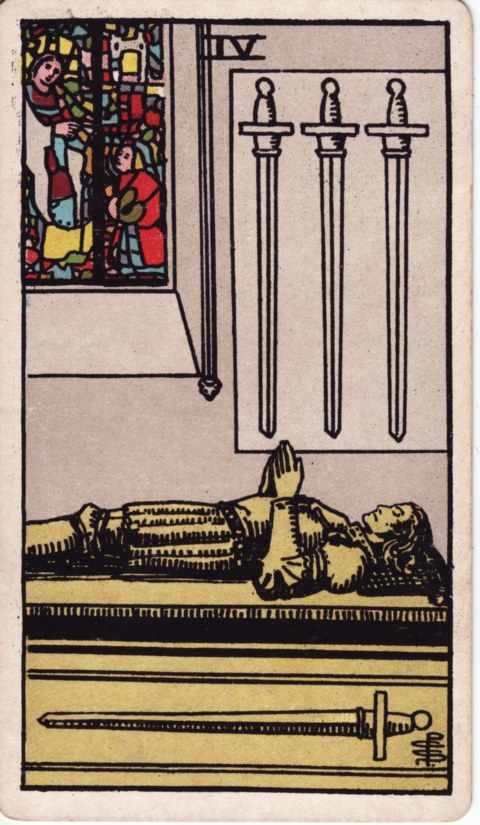
The picture is stillness with the weapons put away. Waite's own words for the figure are "The effigy of a knight in the attitude of prayer, at full length upon his tomb." An effigy is a carving, so what lies there is a monument to a fighter, and the blades hang in sight and out of reach. His list for the card opens with "Vigilance, retreat, solitude, hermit's repose, exile, tomb and coffin," and he says of the last two, "It is these last that have suggested the design." The tomb came first and the rest of the meaning followed from it. At work this week, move one deadline or decline one new request, and leave the gap in your calendar empty.
Book T reads the same card as the far side of a fight. Its meaning speaks of peace "from and after war," and its Tree of Life gloss is "Convalescence, recovery from sickness; change for the better." Nobody in the picture is fighting now, and the swords above the knight show what the rest follows. That ordering is easy to miss on pages that treat the card as a spa day. Waite's first word is vigilance: the rest is a guarded one.
The medical word in Book T needs a plain caution. The card is about a pause and a recovery in the Golden Dawn's sense of the term, and it does not say if you are ill or when you will be well. For the body, ask a doctor. For the rest of your life, the card's request is small and specific: stop for a stretch, and let the stopping be visible to others.
Four of Swords reversed: burnout, or hiding too long?
Reversed, the Four of Swords splits in two. Labyrinthos lists "restlessness, burnout" among its reversed keywords, which is the knight who cannot lie still because the mind keeps working. Tarot.com puts the dividing line as a question: "Are you using rest as a tool for renewal or as an excuse to disconnect?" A pause that began as healing can turn into hiding. At work this week, write the one handover note or administrative task you have been avoiding and cap the day at a fixed hour, so that rest has a start and an end.
Waite's reversed list does not mention burnout at all. It reads "Wise administration, circumspection, economy, avarice, precaution, testament," and testament is the old word for a will. In his book the reversed card is about order: papers, accounts, provisions. His later section is blunter about the upright card, "A bad card, but if reversed a qualified success may be expected by wise administration of affairs." So for Waite the knight getting up and putting the estate in order is the better outcome, and avarice sits in the same list, which may be read as a warning that economy can sour.
Try the empty-hands test when you draw it alone. Recall the last time you sat for twenty minutes with nothing in your hands, phone included. If you can name it from this week, the card is warning about a pause that has become avoidance, and the move is to pick one small task and start it. If you have to go back more than a month, the card is the restless side, and the move is to schedule the twenty minutes before you decide anything else.
If you asked whether a quiet ex will come back, or whether someone's silence means they are done, the card does not speak for them. It describes your own pause and whether it is restful or restless. Burnout and illness are questions for a doctor or a therapist, and tarot is no stand-in for either.
Is the Four of Swords a yes or no card?
| Position | Answer |
|---|---|
| Upright | Not yet, rest first |
| Reversed | Wait, check your energy |
Upright, the Four of Swords says not yet. Asked whether to sign, confront, launch or reply today, the card leans toward waiting a night. It is a yes to rest and a quiet week.
Reversed, it asks you to check your energy first: either you have rested too long and should move, or you have not rested at all and should stop. Neither Waite nor Book T answers such questions; this is current convention.
What does the Four of Swords mean for a relationship or a friendship?
In a relationship
Under one roof, this card is a breather. It fits the quiet after a fight, a week apart, or two tired people who need sleep more than a talk. Labyrinthos adds that needing time alone "doesn't spell the end of the relationship." Agree on how long the break lasts, so that silence does not get read as a verdict.
Single
Single, it asks you to stop searching for a while. Labyrinthos describes someone who has dated hard and ended up drained. If you are only just out of a hurtful ending, the card follows the Three of Swords in Book T's order and says to let the wound close before the next attempt.
As feelings
As someone's feelings, the Four of Swords describes a person who is pausing to sort things out. They may care and still need room. The card shows their state and cannot say how long it lasts or what they will do. If you want to know, ask them, once, and then give them time to answer.
When a friend in crisis wears you out
You have been the one who picks up every call since your friend's bad month, and the Four of Swords says you are allowed to stop. Waite's list begins "Vigilance, retreat, solitude," so you still care and stay reachable, only less often. Tell your friend when you will be back in touch.
Reversed, the pause either drags into avoidance or never starts, and you keep answering at 2 a.m. while resenting it. Set one limit you can keep this week, such as no calls after ten, and say it kindly.
Reversed in love
Turned upside down where love is the topic, it often means a rest that has turned into distance, or restlessness that makes it hard to settle. If you have been chasing someone, give space and fill your own days. The reversed card says nothing about whether an ex returns; it asks what you do with the quiet.
Four of Swords at work and with money
At work the card marks the gap between projects, a leave, a sabbatical or a quiet period after a deadline. Biddy Tarot treats it as a time to review your progress so far and re-assess your priorities. Where money is concerned, it says to hold steady: no large purchase or new investment, and no change of plan while you are tired.
Reversed, the Waite side applies: look at your administration. Reconcile one account, update your papers, or write down who gets what if something happens to you. If you are exhausted, the reversed card means the rest is overdue, and you should say so to your manager before you make a mistake.
Four of Swords as advice and as a person
As advice, take a real break and make it visible. Tell one person that you are off until a given day. Put the swords on the wall: close the open tabs and mute the group chats, then write down the three tasks you will pick up when you return.
For a person, imagine a night nurse named Halina, who has just finished a long run of shifts after a crisis on her ward. She sleeps through the day, answers no calls, and wakes with a list of what she will fix. She is the card's figure, resting with her armor close by. Reversed, the advice is to ask whether you are resting or hiding, and to book one thing in the diary that has a date on it.
How to read the Four of Swords in a spread
Alone, the Four of Swords is the answer: stop and recover first. Pulled for a question about a decision, it points to waiting; pulled for a mood, it names exhaustion; pulled for a relationship, it names a pause.
Sitting in the past slot, it marks a rest or retreat that shaped the present. In the present slot the card says to stand down now, and as an outcome it promises recovery after the effort you are describing. Book T's dignity rule says "Swords are friendly with Cups and Wands," so Cups or Wands beside the card make the rest warmer or more purposeful. The Three of Swords before it makes this the aftermath of a hurt, and the Five of Swords after it is a reminder that the quiet may not last.
The Four of Swords among the Swords
In Book T the Four of Swords sits between a sorrow and a defeat. The Three is the Lord of Sorrow, and the Five of Swords is the Lord of Defeat. The Four is therefore a pause in a hard run, which fits Waite's grim tone. The rose that the Three cuts apart is back at the crossing of the four blades here; that story is told on the Three of Swords page.
That makes it a short respite. The picture does not say how long the knight lies there. What it shows is that the suit allows itself one card of quiet before the next blow.
- Ace of Swords
- Two of Swords · Peace Restored
- Three of Swords · Sorrow
- Four of Swords · Rest from Strife
- Five of Swords · Defeat
- Six of Swords · Earned Success
- Seven of Swords · Unstable Effort
- Eight of Swords · Shortened Force
- Nine of Swords · Despair and Cruelty
- Ten of Swords · Ruin
- Page of Swords
- Knight of Swords
- Queen of Swords
- King of Swords
Titles after the numbered cards are the Golden Dawn's names for them in Book T.
Symbolism of the Rider–Waite–Smith card
- The effigy. Waite says the figure is an "effigy," so it is a carving of a knight in golden armor, laid out on a tomb. A carved figure cannot get up, which makes the rest permanent-looking. We read it as a rest that borrows the look of death and is not one.
- Hands joined in prayer. The hands are pressed together upright on the chest. Waite calls the posture "the attitude of prayer." It is the only action in the picture, and it is a quiet one.
- Three swords on the wall, one by the tomb. Three blades hang point down on the wall above the knight and a fourth lies along the side of the tomb. Waite does not describe them in his short picture text, and Book T draws four swords crossing in the middle instead. Our reading is that the hanging blades show what the rest is rest from.
- The stained-glass window. A window of colored glass fills the upper corner of the wall, with figures in it. Waite does not mention it. It puts the scene inside a church, which is where effigies lie, and it is the one patch of bright color on the card.
What the oldest sources say
“Vigilance, retreat, solitude, hermit's repose, exile, tomb and coffin. It is these last that have suggested the design. Reversed: Wise administration, circumspection, economy, avarice, precaution, testament.”
“A bad card, but if reversed a qualified success may be expected by wise administration of affairs. Reversed: A certain success following wise administration.”
“Rest from sorrow; yet after and through it. Peace from and after war. Relaxation of anxiety. Quietness, rest, ease and plenty, yet after struggle. Goods of this life; abundance; modified by dignity as is usual.”
Waite wrote two lists. The first one pairs rest words (retreat, solitude, repose) with grave words (exile, tomb, coffin), and his remark that the grave words "suggested the design" shows the picture came from the darker end of the list. The second, in his additional meanings, is "A bad card," softened for the reversed card, "A certain success following wise administration." Modern pages invert that: they treat the upright card as the kind one. Waite's reversed list is also the one with money in it: "economy," "avarice," "testament."
Book T gives the card the title "The Lord of Rest from Strife." One more detail in the same text: it says "Goods of this life; abundance; modified by dignity as is usual." That is comfort in the plain sense, with a condition attached, since the Golden Dawn read each card by its neighbors.
Four of Swords and Jupiter in Libra: the card's decan
| Suit and element | Swords, Air (Major Arcana card of air: The Fool) |
|---|---|
| Decan | 20° to 30° ♎︎ Libra, the third ten degrees of the sign |
| Planet of the decan | Jupiter (Major Arcana: Wheel of Fortune) |
| Major Arcana card of Libra | Justice |
| Golden Dawn title | The Lord of Rest from Strife |
| Place on the Tree of Life | Chesed (Book T: “Convalescence, recovery from sickness; change for the better”) |
Attributions from Book T (Golden Dawn, c. 1892; printed 1912).
Book T hands the Four of Swords the last ten degrees of Libra, 20° to 30°, with Jupiter as its planet: "Above and below, on the points of two small daggers, are" Jupiter and Libra. The sign is air, like the suit. Its trumps are Justice for Libra, the Wheel of Fortune for Jupiter and The Fool for air.
King of Cups claims this slice inside his larger zone, as the first of three decans. The Sun crosses it from October 13 to October 23. In 2026 that pass is over, and the next one is October 13 to 23, 2027. By our ephemeris Saturn sat here between October 2011 and October 2012 and comes back from November 2040 to July 2042, with breaks. Jupiter, the decan's own planet, last crossed it between December 2016 and October 2017 and comes back from November 2028 to September 2029, with breaks.
When the Sun is in the Four of Swords stretch
| Year | Sun enters 20° | Sun leaves (reaches 30° Libra) |
|---|---|---|
| 2026 | Oct 13 | Oct 23 |
| 2027 | Oct 13 | Oct 23 |
| 2028 | Oct 12 | Oct 22 |
| 2029 | Oct 12 | Oct 22 |
This year the Sun crossed the Four of Swords stretch of the zodiac (20° to 30° Libra) from October 13 to October 23, 2026. Next time: October 13 to October 23, 2027 (US Eastern dates).
Dates are US Eastern, from the astronomy-engine ephemeris. Across 35,064 dates from 1930 to 2025, the Sun is in this stretch on 2.8% of them, and at least one of the ten planets is on 25.6%.
Today no slow planet among the five sits in this slice. Neptune was here, on and off, between 1951 and 1957, Uranus from 1972 to 1975, and Pluto from 1979 to 1984. Uranus returns in October 2056, and stays to late 2058. Having one of them in the slice does not mark a person as a rester or a retreater: it is one theme of the Golden Dawn's table, which this card carries.
Is the Four of Swords in your birth chart?
Enter your birth date. We show which of the ten planets stood between 20° and 30° Libra that day, the slice of sky Book T gives this card; add the time if a planet was near the edge.
Enter your birth date above to see your result.
Every planet, angle and house from your birth time: birth chart calculator.
Questions about the Four of Swords
Is the Four of Swords good news or bad?
Modern pages read it as gentle, a card of rest. Waite, in his additional meanings, calls it "A bad card," and his picture is a tomb. Treat it as a pause that you should take on purpose.
What does the Four of Swords mean as feelings?
A person who is pausing to sort out what they feel. They may care and still need room. Reversed, they are restless or avoiding the subject.
Is the Four of Swords yes or no?
Upright, not yet; reversed, check your energy before you decide. Both answers are modern practice, and the old texts give none.
Does the Four of Swords mean he needs space?
It can describe a pause, but it cannot read his mind or promise he returns. Ask once, give time, and look at your own pause meanwhile.
What zodiac sign is the Four of Swords?
Libra, its last third. Book T sets Jupiter over these degrees, and the Sun moves through it from about October 13 to October 23.
When will the rest end?
A card gives no dates. October 13 to 23 covers the Sun's pass through the decan, and its next one is in 2027. It is a calendar convention only.
Does the Four of Swords mean illness?
No. Book T mentions convalescence, but a card cannot diagnose anything. If your health worries you, ask a doctor.
Sources
- Astronomy Engine: the open-source ephemeris library behind our planet positions, dates and statistics
- A. E. Waite, The Pictorial Key to the Tarot (1911), Wikisource: the divinatory meanings we quote, upright and reversed
- Book T (Golden Dawn), as printed in The Equinox I:8, 1912: the zodiac sign, Hebrew letter, title and short meaning of each card
- Wikimedia Commons: Rider–Waite–Smith tarot deck: Pamela Colman Smith's 1910 card drawings, public domain
- How we create our readings: our own calculation of sign dates, positions and the 1930 to 2025 statistics
Next to the Four of Swords
In the suit of Swords: Three of Swords ← Four of Swords → Five of Swords.
Libra on this site: Libra zodiac sign · Justice, the card of Libra · your full birth chart.
All 22 Major Arcana with their signs and planets, and the minor cards written so far: tarot card meanings.
Written by The Zodiac Atlas editorial team with the help of AI and edited by a person. Quotations are from Waite's Pictorial Key to the Tarot and the Golden Dawn's Book T, both in the public domain; the card picture is a 1910 printing of Pamela Colman Smith's drawing for the 1909 deck. Sun dates and planet positions come from the astronomy-engine ephemeris (tropical zodiac). Tarot and astrology are symbolic traditions; they do not predict events.