Five of Swords upright: who really won the fight?
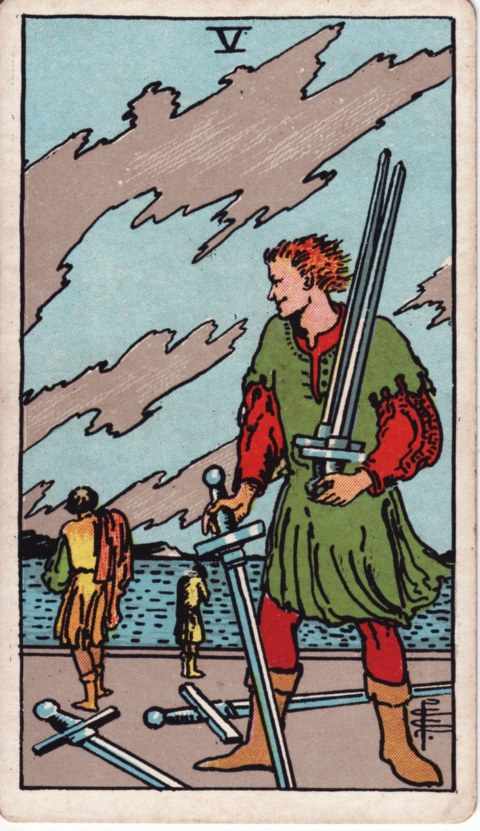
Waite's picture line gives the field to one man: "A disdainful man looks after two retreating and dejected figures," and "He is the master in possession of the field." Tarot.com calls the card "a win … but at what cost?" Biddy Tarot reads it from the other side: even the person who came out ahead may have lost as much trust and respect as the opponent. At work this week, pick the dispute where you are ahead, write in one line what it has cost in goodwill so far, and send that line to nobody until you have decided whether the win is worth it.
The old lists contain no victory at all. Book T opens with "Contest finished and decided against the person," and the two walking figures are the loud part of the picture. So the card can mean you are the winner counting the damage, the loser who has just been beaten, or a bystander watching a match end badly.
Book T also describes a character, and it is the gossip: "A busybody and separator of friends, hating to see peace and love between others," who is also "Clever and quick in thought and speech." That is a person who wins by splitting people. When the card turns up in a question about a circle of friends, a team or a family, ask who benefits from the rift, and ask whether you have been carrying that person's stories.
Five of Swords reversed: sorry, revenge or goodbye?
Reversed, Waite writes "The same; burial and obsequies." Nothing in it gets softer. The loss is still there, and now there is a funeral to go with it: something has finished, and the question is what you do at the graveside. Labyrinthos lists "reconciliation, resolution, compromise, revenge, regret, remorse, cutting losses" for the turned card, which shows how many roads lead out of the same quarrel. This week at work, if a dispute has gone quiet, write down the one thing you will let go (a claim, a line on an invoice, a grudge) and tell the single person it concerns.
Those roads sort into three. Repair means somebody says sorry first and the sides meet halfway. Revenge or regret means the fight is over on paper but one side keeps going over it at night. Burial means the friendship or deal is closed for good, and the sensible act is to stop paying for it. Waite's second list adds "A sign of sorrow and mourning," so he expected grief in the reversed card, with no tidy reconciliation attached.
Try the apology test with a pen: write one sentence that begins "I am sorry that I" and names your own part in the quarrel, then look for the word "but" or the phrase "if you." If the sentence is finished in a minute without either, you are on the repair side, and whether to send it is a separate decision. If every try grows a "but," you are still holding the field. That is Waite's "the same": nothing is mended, so wait a day before saying anything.
For an ex, a friend's forgiveness or a court case, the card gives no verdict. It describes where you stand in the quarrel and names no winner or date. For a lawsuit, a lawyer is the one to ask.
Is the Five of Swords a yes or no card?
| Position | Answer |
|---|---|
| Upright | No, not at this price |
| Reversed | Wait, let it settle |
Upright, this card says no. Tarot.com puts it bluntly, "the answer is NO," and the picture agrees that the thing you want is bought with someone else's loss. A question like "should I go on with this fight?" gets a no from the card, and a question about dropping it gets a yes.
Reversed, the advice is to wait. Let the quarrel finish before you ask again, because the question will change once it has. Waite and Book T leave the question open; the two answers above are how readers work now.
Five of Swords in love and friendship: rows, third parties, feelings
In a relationship
In a couple the Five of Swords fits the argument that one person wins and both people lose. The sharp reply lands, the other goes quiet, and the room feels worse. Book T adds a second reading, the "separator of friends": a relative, an ex or a friend who stirs things and likes to see the two of you at odds. Nothing proves anyone is doing this, so use the idea as a prompt: whose version of the quarrel did you hear first?
Single
Single, the card points to rivalry for someone's attention, a friendship cooled by a flirtation, or a habit of winning conversations with dates. Being right does not build closeness. If the card describes you, try asking the next person one real question and letting their answer stand.
As feelings
As someone's feelings toward you, it shows a person who is either triumphant and uneasy or stung and withdrawn. Book T's line about "Feelings of pity easily roused, but unenduring" fits: a flash of sympathy that fades by the next day. The card shows the mood after a fight and leaves the person's next move unstated.
Can a friendship be repaired after a group chat fight?
A fight that split a group chat fits the Five of Swords closely. Book T calls the card's person a separator of friends, so ask who stirred it and who kept passing things along. Reversed, Waite's line is "The same; burial and obsequies." That leans toward an ending, yet it does not decide for your friend or say they will stay silent.
Whether it can be repaired depends on a reply the card cannot see. What you can do is write to them alone, outside the group, name your own part and leave out the word but. Send it, then stay out of the group's debate while you wait.
Reversed in love: sorry, revenge or goodbye?
Reversed in a love reading, it offers three outcomes: a sincere apology, a grudge that keeps its grip, or an ending that is final. Waite's "burial" leans to the last one. If you are thinking of going back to an ex, look at which of the three the last fight resembled, and whether anyone has said sorry without a "but."
Five of Swords at work and with money
On the job it shows a turf war, a credit grab or a meeting that someone won by being loud. Book T's "Clever and quick in thought and speech" is the colleague who can out-argue the room. The warning in today's pages is about what the win does to the team around you. Pick your fights, put the facts in writing, and keep the conversation about the task. If the workplace is turning hostile, HR exists for that.
With money, Waite's second list says "An attack on the fortune of the Querent," and Book T lists "poverty, avarice, grieving after gain." Read as a caution, that means disputes over a bill, a bonus or a shared account, and the temptation to keep a sum you were not owed. Reversed, a work dispute may be settled, closed or buried, so check which one before you rely on it. On money, a settled claim should end with a written receipt.
Five of Swords as advice and as a person
As advice, decide whether the point is worth the field. Ask what the other person will have lost when you are finished, and whether you will still want to talk to them afterward. Pick the one claim you will keep and give up the other four.
Taken as a person, it is a quick, clever talker who likes to be proved right. Colm, a made-up project lead, wins the budget argument in every meeting and then finds that his team sends him fewer ideas. Book T's "unenduring" pity is his pattern: sorry for a day, back on the field the next. When the card is reversed, say the apology and then stop defending the argument.
How to read the Five of Swords in a spread
Drawn alone, the Five of Swords says there is a quarrel inside your question, and that one side is going to get less than it wants. Decide whether you are the person on the field or one of the two walking off.
If it lands in the past, it marks the fight the question grew out of; in the present, the fight is still live; as the outcome, it warns about the price of the path. A Pentacles card nearby tilts the quarrel toward money or property, and the dignity table backs that with "Swords are inimical to Pentacles." Cups sit more kindly beside Swords in the same rules, and a Cup next to the card leaves room for an apology. The Four of Swords before it is rest before the blow, the Three of Swords means the hurt has already landed, and the Six of Swords after it means leaving the scene.
The Five of Swords among the Swords
The rose tells the Swords story, and in the Five it breaks again. In Book T's Four of Swords the rose of five petals is reinstated in the centre of the blades. In the Five, "The petals of the rose, which in the four had been reinstated in the centre, are torn asunder and falling." In the Six it is back: "Rose re-established thereon." The first half of the story, Two to Four, sits on the page for the Three of Swords. The Five is the second break, a rose with nothing left holding it together.
Pamela Colman Smith drew no rose and no angelic hands. She drew a man, two walkers and a ragged sky, so a diagram of a broken design becomes a scene. A picture raises the question of who won, while Book T only says who lost.
- Ace of Swords
- Two of Swords · Peace Restored
- Three of Swords · Sorrow
- Four of Swords · Rest from Strife
- Five of Swords · Defeat
- Six of Swords · Earned Success
- Seven of Swords · Unstable Effort
- Eight of Swords · Shortened Force
- Nine of Swords · Despair and Cruelty
- Ten of Swords · Ruin
- Page of Swords
- Knight of Swords
- Queen of Swords
- King of Swords
Titles after the numbered cards are the Golden Dawn's names for them in Book T.
Symbolism of the Rider–Waite–Smith card
- The smirking young man. He wears a green tunic, and his smile is Waite's "disdainful" look. He carries two swords on his shoulder and rests his hand on a third with the point down. Many modern readers see the face of a winner who enjoys it. Book T gives no face at all.
- Two swords on the ground. Two blades lie on the ground, where the others dropped them. In our reading, they are the price of the contest: the other side has surrendered what it fought with. Waite says only that "Their swords lie upon the ground."
- Two figures walking to the water. They go toward the sea with their backs to the winner. Waite calls them "retreating and dejected," and with their shoulders slouched they are often read as a loss shared by both sides.
- Torn, windblown clouds. The sky is broken into streaks, which readers often take as a sign that not everything is well though the fighting is over. The clouds echo Book T's rose, torn and falling; that link is ours.
What the oldest sources say
“Degradation, destruction, revocation, infamy, dishonour, loss, with the variants and analogues of these. Reversed: The same; burial and obsequies.”
“An attack on the fortune of the Querent. Reversed: A sign of sorrow and mourning.”
“Contest finished and decided against the person; failure, defeat, anxiety, trouble, poverty, avarice, grieving after gain, laborious, unresting; loss and vileness of nature; malicious, slanderous, lying, spiteful and tale-bearing. A busybody and separator of friends, hating to see peace and love between others. Cruel, yet cowardly, thankless and unreliable. Clever and quick in thought and speech. Feelings of pity easily roused, but unenduring.”
Waite gives the card two lists. The first, "Degradation, destruction, revocation, infamy, dishonour, loss," is made entirely of losses, though his picture line names a winner. In the second list the card is "An attack on the fortune of the Querent," and reversed, "A sign of sorrow and mourning." Neither list uses the word victory. The smirking-winner reading is drawn from the picture and today's pages, and Waite's words are about what remains after the field is taken.
Book T names it "The Lord of Defeat" and puts it in Geburah, the fifth sphere, with the short gloss "Defeat, loss, malice, spite, slander, evil-speaking." The longer list is nearly all a portrait of a person: "Cruel, yet cowardly, thankless and unreliable." Even the one soft line, "Feelings of pity easily roused, but unenduring," is qualified. The Golden Dawn's reader was warned about a character as much as an event, and you can use that when someone in the question is spreading talk.
Five of Swords and Venus in Aquarius: the card's decan
| Suit and element | Swords, Air (Major Arcana card of air: The Fool) |
|---|---|
| Decan | 0° to 10° ♒︎ Aquarius, the first ten degrees of the sign |
| Planet of the decan | Venus (Major Arcana: The Empress) |
| Major Arcana card of Aquarius | The Star |
| Golden Dawn title | The Lord of Defeat |
| Place on the Tree of Life | Geburah (Book T: “Defeat, loss, malice, spite, slander, evil-speaking”) |
Attributions from Book T (Golden Dawn, c. 1892; printed 1912).
Book T gives the Five of Swords the first ten degrees of Aquarius, with Venus as its planet: "Above and below are Venus and Aquarius for Decan." Aquarius is air as well, matching the suit, and the three trumps that go with it are The Star (Aquarius), The Empress (Venus) and The Fool (air).
Venus, the planet of attraction and agreement, sits over a card of rupture; the contrast is ours and is not in Book T. Traditional astrology gives Aquarius to Saturn, and no dignity is claimed for Venus here. The decan sits within the King of Swords zone on this site.
When the Sun is in the Five of Swords stretch
| Year | Sun enters 0° | Sun leaves (reaches 10° Aquarius) |
|---|---|---|
| 2026 | Jan 19 | Jan 29 |
| 2027 | Jan 20 | Jan 29 |
| 2028 | Jan 20 | Jan 30 |
| 2029 | Jan 19 | Jan 29 |
This year the Sun crossed the Five of Swords stretch of the zodiac (0° to 10° Aquarius) from January 19 to January 29, 2026. Next time: January 20 to January 29, 2027 (US Eastern dates).
Dates are US Eastern, from the astronomy-engine ephemeris. Across 35,064 dates from 1930 to 2025, the Sun is in this stretch on 2.7% of them, and at least one of the ten planets is on 25.7%.
Pluto is in this decan now. By our ephemeris it entered on March 25, 2023, went back and forth through 2023 and 2024, and has stood here since November 20, 2024, until March 29, 2029, then returns with breaks until December 1, 2030. Jupiter and Saturn were both here at the Great Conjunction of December 21, 2020: Jupiter from December 21, 2020 to February 1, 2021, and Saturn from December 19, 2020 to March 17, 2021. Uranus was in the decan in 1995 to 1998 and Neptune in 1998 to 2003. Saturn's next stay begins in January 2050. These dates are a calendar, not a forecast.
Is the Five of Swords in your birth chart?
Enter your birth date. We show which of the ten planets stood between 0° and 10° Aquarius that day, the slice of sky Book T gives this card; add the time if a planet was near the edge.
Enter your birth date above to see your result.
Every planet, angle and house from your birth time: birth chart calculator.
Questions about the Five of Swords
Is the Five of Swords a card to fear?
It sits among the harder Swords, since the old lists are mostly losses. It also works as a warning, because it shows the cost while you can still change course.
How does the Five of Swords read as someone's feelings?
A mood after a fight: triumph with unease, or hurt and withdrawal. Book T adds pity that is quickly roused and does not last. The card does not say what the person will do next.
Should I read the Five of Swords as a yes?
Not at this price: upright the card leans toward no, and reversed it says wait until the quarrel has settled. Both old books stay silent on yes and no, so this is modern habit.
What does the Five of Swords reversed mean?
The loss stands, since Waite writes "The same; burial and obsequies." Modern pages read repair, regret or a clean ending. The sentence that starts "I am sorry that I" and has no "but" shows which one you are in.
What does the Five of Swords mean in love or after a fight?
A row where both lose, or a third person who stirs things. It does not prove cheating or an ending. Look at who gave in, and whether anyone said sorry.
What does the Five of Swords mean at work?
A dispute where winning costs goodwill: a credit grab, a turf war, a loud meeting. Settle it with facts in writing, and go to HR if it turns hostile.
Five of Swords and astrology: which sign?
Aquarius, the first ten degrees, under Venus in Book T. No date belongs to the card itself; a reader who wants one can take the Sun, which stands in this slice from about January 19 to January 29.
Sources
- Astronomy Engine: the open-source ephemeris library behind our planet positions, dates and statistics
- A. E. Waite, The Pictorial Key to the Tarot (1911), Wikisource: the divinatory meanings we quote, upright and reversed
- Book T (Golden Dawn), as printed in The Equinox I:8, 1912: the zodiac sign, Hebrew letter, title and short meaning of each card
- Wikimedia Commons: Rider–Waite–Smith tarot deck: Pamela Colman Smith's 1910 card drawings, public domain
- How we create our readings: our own calculation of sign dates, positions and the 1930 to 2025 statistics
Next to the Five of Swords
In the suit of Swords: Four of Swords ← Five of Swords → Six of Swords.
Aquarius on this site: Aquarius zodiac sign · The Star, the card of Aquarius · your full birth chart.
All 22 Major Arcana with their signs and planets, and the minor cards written so far: tarot card meanings.
Written by The Zodiac Atlas editorial team with the help of AI and edited by a person. Quotations are from Waite's Pictorial Key to the Tarot and the Golden Dawn's Book T, both in the public domain; the card picture is a 1910 printing of Pamela Colman Smith's drawing for the 1909 deck. Sun dates and planet positions come from the astronomy-engine ephemeris (tropical zodiac). Tarot and astrology are symbolic traditions; they do not predict events.