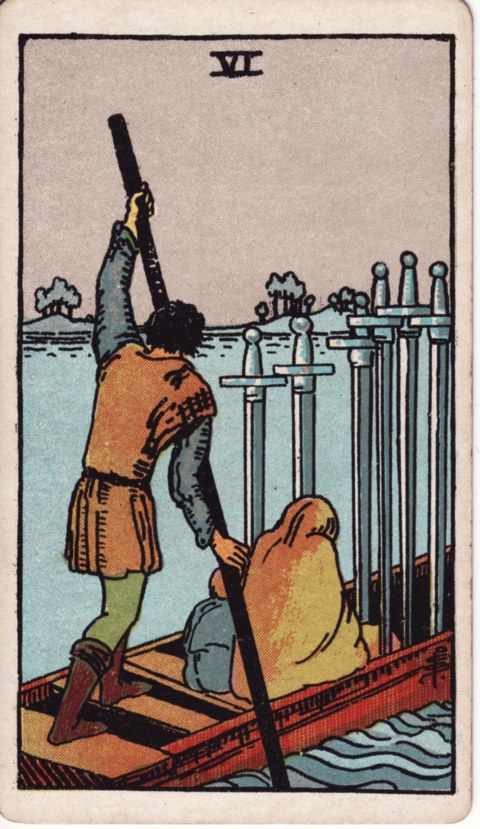
Six of Swords upright: what is the ferryman carrying?
Waite's picture line is plain: "A ferryman carrying passengers in his punt to the further shore. The course is smooth, and seeing that the freight is light, it may be noted that the work is not beyond his strength." Nothing in it says the passengers are fleeing. Biddy Tarot reads the card as a state of transition, "moving house, leaving a relationship, changing jobs," and Waite's own first words, "Journey by water, route, way," fit that. This week, take the one move you have been planning and do its first step, which might be sending the application, booking the viewing or giving notice on paper.
Book T calls the card the Lord of Earned Success and defines it as "Success after anxiety and trouble," which is a calmer verdict than most blogs give. The short gloss there is "Labour, work, journey by water," and it agrees with Waite's first words; we make no claim about whether either writer saw the other's page.
Modern readers add the weight: Tarot.com has the swords as thoughts and memories that come along. That is a fair reading of the picture, though a later layer, since Waite says the work is within the ferryman's strength and the boat is not overloaded.
Six of Swords reversed: stuck, or saying it aloud?
For the turned card Waite has "Declaration, confession, publicity; one account says that it is a proposal of love." Nobody is stuck in that list. The boat goes in the other direction: what was kept below deck is said out loud. Biddy Tarot reads the turned card as "resisting change and transition," which is the usual modern reading, and the two can be put together. Often the thing you resist is the sentence you have not said. At work this week, send the note you keep redrafting, whether it is the resignation, the request for a raise or the correction nobody has made.
Three situations match. First, you are ready to speak and have not: the declaration is yours. In the second you have said it, and the news is now public, with all the attention that brings. In the third you hesitate over a move because a decision was made for you. Waite's second list adds "Unfavourable issue of lawsuit," a legal sense of the turned card that you should not read as a forecast about any case.
Lacking other cards, count the drafts. Find the message you have not sent, whether it is on your phone, in a notebook or only in your head, and count how many versions of it exist. One or two drafts with a named reader means you are close, and what is left is a date. Five versions with no reader named means the card is about talking to yourself first, and the job is to decide who gets the message. If there are no drafts at all, the thing to say has not been found yet.
The "proposal of love" line is no help in guessing whether an ex will return: Waite attributes it to one account only and names no person. The card describes whether you are ready to speak, and that is a separate matter from getting anyone else to speak first.
Is the Six of Swords a yes or no card?
| Position | Answer |
|---|---|
| Upright | Yes, gently |
| Reversed | Not until it is said |
Upright, the Six of Swords leans to a gentle yes. Tarot.com answers YES, and the picture of a calm crossing supports it for questions about leaving, moving or finishing something. It fits worse for a question that needs a quick result, because the boat is slow.
Reversed, speak first: the answer depends on a conversation you have not had. Neither old book prints a verdict for this card, and both answers are modern habit.
Six of Swords in love and friendship: moving on, mending, what they feel
In a relationship
As a couple, the card means a hard patch is being left behind, sometimes together. Tarot.com sees a healing phase "whether together or apart." Book T's word is earned: the calm follows trouble that was lived through. If it comes up before a trip or a house move you share, it is simply that.
Single
On your own, the card points to moving on from an old attachment, with the grief still present and the water turning smooth. Nothing in the picture says a new person waits on the far shore. The card is about leaving, and arriving is another card.
As feelings
Read as what someone feels, it shows a person trying to get distance and calm, or one who has already decided to step back. They may be kind about it. The card describes a mood of leaving and does not say whether you are the one left behind or the one invited into the boat.
Moving away without losing the friends you leave
Waite opens this card with "Journey by water, route, way," and for friends it is the move. One of you is crossing to another city, and the friendship has to cross too. The crossing is calm. A plan, such as a weekly call, is what keeps it alive. Hoping you will stay close does not.
Reversed, Waite's word is "confession": there is something you have not said about leaving, perhaps that you are afraid of being forgotten. This week, say it to that friend, and in the same message pick a date for your first call.
Reversed in love: the proposal line
Reversed, Waite's "one account says that it is a proposal of love" sits beside "confession," so the turned card in love can be a feeling finally put into words. It can also be a secret that comes out. Before you take it as a promise, remember that the line is an echo from one unnamed account.
Six of Swords at work and with money
In a job question the card is a transfer, a new role, a handover or a change of employer that goes smoothly. Book T's "patience, labour" stand for the dull middle of such a change, and Waite's "the work is not beyond his strength" says that it is manageable. Mentioning a move to your manager early is the practical step.
For money, the picture is a light cost: freight, a fare, a modest relocation. Reversed, the word "publicity" may mean the news is out before the paperwork is finished, so keep the terms of any move in writing. On a reversed card the advice is also to tell the person who needs to hear it first, before they hear it from someone else.
Six of Swords as advice and as a person
Let someone else steer where the boat has to go, and use the time to decide what stays aboard. The ferryman has a pole and a clear shore ahead. Name the shore you are aiming for, and that decides what to carry.
Personified, the card is a go-between or helper: a mover, a mediator, a friend who takes you across a bad week. Jonas, a made-up relocation consultant, asks every client the same question, which is what they want to leave behind, and says little otherwise. His fault, in Book T's phrase, might be "conceit." Reversed, the advice is to say what you want aloud once, to one person, before you pack.
How to read the Six of Swords in a spread
On its own, the Six of Swords says you are being carried out of the problem and that the passage is calmer than it feels. The question to ask is which shore you want.
Early in a row it is the crossing already made, in the middle one under way, and at the end a change that works out without drama. Cups and Wands are friendly to Swords in Book T, so a Cup nearby softens the leaving into feeling and a Wand sets the boat moving. A Pentacles card is harder on the crossing, since the table reads "Swords are inimical to Pentacles"; expect money to complicate the move. Next to the Five of Swords it follows a quarrel, and next to the Seven of Swords the passage may carry something that does not hold.
The Six of Swords among the Swords
Of the three Swords cards Book T puts in Aquarius, the Six comes second. The Five before it is Defeat, and the Seven after it is Unstable Effort. Of the three, the Six alone has a verdict that is not a loss. Success comes straight after defeat and before the instability, so it reads as relief that the suit allows once and does not extend.
The rose supplies the second link. The Five of Swords page covers how the petals were torn and falling; here Book T says only "Rose re-established thereon." The picture of the ferry shows no rose, and what Pamela Colman Smith put in its place is still water on one side, with ripples nearest the boat.
- Ace of Swords
- Two of Swords · Peace Restored
- Three of Swords · Sorrow
- Four of Swords · Rest from Strife
- Five of Swords · Defeat
- Six of Swords · Earned Success
- Seven of Swords · Unstable Effort
- Eight of Swords · Shortened Force
- Nine of Swords · Despair and Cruelty
- Ten of Swords · Ruin
- Page of Swords
- Knight of Swords
- Queen of Swords
- King of Swords
Titles after the numbered cards are the Golden Dawn's names for them in Book T.
Symbolism of the Rider–Waite–Smith card
- The ferryman at the back. He stands behind the passengers and works a long pole. Waite calls him a ferryman with a punt, and a punt is moved by pushing against the bed of shallow water.
- The hooded figure and the smaller one. The two passengers sit with their backs to us, one in a hood and cloak, one smaller. Waite says only "passengers," and the picture shows two people leaving together.
- Six upright swords. They stand in the boat like a fence. Book T draws two hands with two crossing swords each and a rose, and Smith made the swords a cargo. Waite says the freight is light.
- Rough water and smooth water. The surface is rippled on the right, beside the boat, and smooth across the rest of the water. The point of the card is in that contrast, usually read as rough water behind and a calm far shore.
What the oldest sources say
“Journey by water, route, way, envoy, commissionary, expedient. Reversed: Declaration, confession, publicity; one account says that it is a proposal of love.”
“The voyage will be pleasant. Reversed: Unfavourable issue of lawsuit.”
“Success after anxiety and trouble; self-esteem, beauty, conceit, but sometimes modesty therewith; dominance, patience, labour, etc.”
Waite's first list is short and about travel: "Journey by water, route, way, envoy, commissionary, expedient." The words after the journey are all ways of getting something done, and none is a feeling. Only in the reversed line does the card turn to speech. His later list is simply "The voyage will be pleasant," with the reverse "Unfavourable issue of lawsuit." The old reading is therefore practical and mild, and heaviness is a modern addition.
Book T pairs the title "Earned Success" with a meaning that begins "Success after anxiety and trouble" and ends with "dominance, patience, labour, etc." In between come "self-esteem, beauty, conceit, but sometimes modesty therewith." The sphere is Tiphareth, glossed "Labour, work, journey by water." Beauty and conceit are odd companions for a ferry, which suggests that the Golden Dawn read the card as success you can be proud of, with a risk of showing off.
Six of Swords and Mercury in Aquarius: the card's decan
| Suit and element | Swords, Air (Major Arcana card of air: The Fool) |
|---|---|
| Decan | 10° to 20° ♒︎ Aquarius, the second ten degrees of the sign |
| Planet of the decan | Mercury (Major Arcana: The Magician) |
| Major Arcana card of Aquarius | The Star |
| Golden Dawn title | The Lord of Earned Success |
| Place on the Tree of Life | Tiphareth (Book T: “Labour, work, journey by water”) |
Attributions from Book T (Golden Dawn, c. 1892; printed 1912).
In Book T the Six of Swords takes the middle decan of Aquarius, with Mercury as planet: "Mercury and Aquarius above and below, supported on the points of two short daggers or swords." Air is the suit's element and Aquarius's too. Linked trumps: The Star, The Magician and The Fool.
Astrologers give Mercury messages, routes and exact work, which fits the "route, way, envoy" of Waite's list and the reversed "declaration." That connection is our own and is not stated in Book T. On this site the King of Swords page covers the larger zone that holds the decan.
When the Sun is in the Six of Swords stretch
| Year | Sun enters 10° | Sun leaves (reaches 20° Aquarius) |
|---|---|---|
| 2026 | Jan 29 | Feb 8 |
| 2027 | Jan 29 | Feb 8 |
| 2028 | Jan 30 | Feb 9 |
| 2029 | Jan 29 | Feb 8 |
This year the Sun crossed the Six of Swords stretch of the zodiac (10° to 20° Aquarius) from January 29 to February 8, 2026. Next time: January 29 to February 8, 2027 (US Eastern dates).
Dates are US Eastern, from the astronomy-engine ephemeris. Across 35,064 dates from 1930 to 2025, the Sun is in this stretch on 2.7% of them, and at least one of the ten planets is on 23.8%.
By our ephemeris Saturn was in this decan in 2021 and 2022 (March 17 to August 6, 2021; December 14, 2021 to March 12, 2022; September 12 to December 5, 2022), and before that in 1992 and 1993. Uranus was here in 1998 to 2001 and Neptune from 2002 to 2007. Pluto is the next to enter, on March 29, 2029, and remains, on and off, until January 2037. No planet from Saturn out is in the decan today, and the list forecasts nothing.
Is the Six of Swords in your birth chart?
Enter your birth date. We show which of the ten planets stood between 10° and 20° Aquarius that day, the slice of sky Book T gives this card; add the time if a planet was near the edge.
Enter your birth date above to see your result.
Every planet, angle and house from your birth time: birth chart calculator.
Questions about the Six of Swords
What does the Six of Swords mean when moving on?
A calm crossing away from a hard stretch: moving house, leaving a relationship or changing jobs all fit. Waite adds that the load is light and the work is within the ferryman's strength.
Is the Six of Swords a happy card?
Mostly good. Book T calls it Earned Success, and Waite's later list says "The voyage will be pleasant." The sadness in the picture belongs to modern readings.
What are the feelings behind the Six of Swords?
A wish for distance and calm, or a decision to step back. It can be gentle. The card does not say whether you are included in the plan.
What does the Six of Swords reversed mean?
Counting the unsent drafts of a message shows which reading fits. Waite gives "Declaration, confession, publicity," while modern pages read resistance to change.
Is the Six of Swords an answer of yes?
A gentle yes when upright. Reversed, say what needs saying first. The old sources attach nothing of the kind.
Will my ex come back with the Six of Swords?
The card cannot say. Upright it speaks of leaving, reversed of speaking, and Waite's "proposal of love" is one unnamed account.
Six of Swords: which sign, which dates?
Aquarius, 10° to 20°, with Mercury as its planet in Book T. It names no day; as a calendar anchor, the Sun crosses this slice from about January 29 to February 8.
Sources
- Astronomy Engine: the open-source ephemeris library behind our planet positions, dates and statistics
- A. E. Waite, The Pictorial Key to the Tarot (1911), Wikisource: the divinatory meanings we quote, upright and reversed
- Book T (Golden Dawn), as printed in The Equinox I:8, 1912: the zodiac sign, Hebrew letter, title and short meaning of each card
- Wikimedia Commons: Rider–Waite–Smith tarot deck: Pamela Colman Smith's 1910 card drawings, public domain
- How we create our readings: our own calculation of sign dates, positions and the 1930 to 2025 statistics
Next to the Six of Swords
In the suit of Swords: Five of Swords ← Six of Swords → Seven of Swords.
Aquarius on this site: Aquarius zodiac sign · The Star, the card of Aquarius · your full birth chart.
All 22 Major Arcana with their signs and planets, and the minor cards written so far: tarot card meanings.
Written by The Zodiac Atlas editorial team with the help of AI and edited by a person. Quotations are from Waite's Pictorial Key to the Tarot and the Golden Dawn's Book T, both in the public domain; the card picture is a 1910 printing of Pamela Colman Smith's drawing for the 1909 deck. Sun dates and planet positions come from the astronomy-engine ephemeris (tropical zodiac). Tarot and astrology are symbolic traditions; they do not predict events.