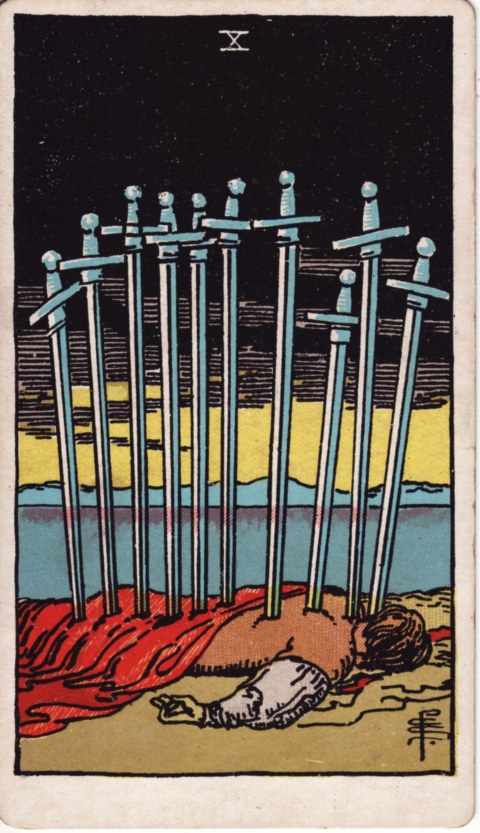
Is the Ten of Swords the worst card? What it means
Is the Ten of Swords the worst card in the deck? It is the most dramatic picture, but the card is less grim than it looks. The ending has already happened. Waite adds a caution of his own: "It is not especially a card of violent death." Ten swords is the end of the line for the suit. Nothing more can be added. Tarot.com puts the mood well: "There's quiet liberation here, too."
Waite's upright list begins with the picture itself, "Whatsoever is intimated by the design," and goes on to "pain, affliction, tears, sadness, desolation." Those words describe the feeling after the blow. Modern readers name the blow: a layoff, a breakup, a betrayal by someone close, a burnout that finally forces a stop. Biddy Tarot says the ending comes as if "out of the blue," and that is the common thread. The collapse feels sudden. Often it had been building for a long time.
Look at what the picture holds besides the swords. The sky is black, but a strip of yellow light lies along the horizon, and the water is flat. Calm, almost. Biddy Tarot writes "The hour is darkest before dawn" and, in the same passage, that the card marks "the final ordeal." We would add a limit to that comfort. The dawn in the picture sets no schedule for yours. One thing is certain: this particular source of pain has finished.
Ten of Swords reversed: recovery or refusing to let go?
Reversed, the Ten of Swords gives two readings, and Waite's is the odd one out: "Advantage, profit, success, favour, but none of these are permanent; also power and authority." That gain does not last. It suits a card at the end of the suit. Modern readers turn the reversal toward recovery. Labyrinthos lists "survival, improvement, healing, lessons learned" along with "despair, relapse."
The other modern reading is resistance. Tarot.com says the reversal can mean "something needs to end, but you're still hanging on," and Biddy Tarot says the more you resist, "the more this situation will continue to drag on." In our reading this is the person who knows it is over. Life is still arranged as if it were not.
Try this with a single card. Write one sentence about the ending in the past tense, with a date or a month: "The department closed in March." "We stopped talking in June." If the sentence comes easily, you are on the recovery side, and the card is telling you to rebuild. If you can only write it with "if" and "when" ("if he calls," "when they change their minds"), the ending has not been accepted yet. That is the part to work on.
Asking whether someone will come back? Upright, the Ten of Swords describes the end of something. Reversed, it describes how you stand toward that end, as in the sentence test above. The other person's plans are not in the picture. Any decision about reaching out is yours, so make it with the ending written down in the past tense.
Is the Ten of Swords a yes or no card?
| Position | Answer |
|---|---|
| Upright | No |
| Reversed | The worst has passed; ask again about what is next |
The Ten of Swords is a clear no, and Tarot.com also answers NO. We take it as a no to continuing the same way: do not put more into a plan, job or relationship that this card has already named as finished.
Reversed, it says the worst is behind you, or gives a no that you are not ready to hear. If your question was about leaving something, the reversed card leans toward yes. Verdicts of this kind appear in neither source; they are our own judgement.
Ten of Swords in love and friendship: a breakup, a betrayal, or relief?
In a relationship
If you are with someone, the Ten of Swords points to a rupture that cannot be repaired by one more conversation: a betrayal, a final argument, or the slow end of something that stopped working long ago. Biddy Tarot reads the stab in the back as another person's betrayal. That is one case. The card also fits a mutual ending where nobody did anything wrong. Which one is yours? Ask before you decide how to feel.
Single
Without a partner, the card most often points back to a past relationship that you are still carrying. Tarot.com notes that you are "not meant to carry old swords into new relationships." Our practical reading is that the person you meet next should not have to pay for the last one.
As feelings
As someone's feelings, the Ten of Swords means they are at a low point, hurt or worn out, and often cannot say so. If the feeling is about you, it can mean they consider the connection finished. Take that seriously. Ask them directly if you need to know.
When a friendship is over and stays over
Some friendships end and stay ended. The Ten of Swords is that final point, after the betrayal, the last argument or the long fade. Waite's side list for the card speaks of "treason on the part of friends", yet it also fits an ending where nobody plotted anything. It says the friendship is done and leaves fault open.
Reversed, you begin to recover, or you keep poking at it and rereading old messages for a way back. Ask yourself whether you are grieving or still negotiating. Then mute the thread, return what you borrowed, and decide what you will say if a mutual friend asks.
Reversed in love
Read reversed for a relationship, the Ten suggests healing after a breakup, or a stubborn attachment to something that is already over. Tarot.com's advice for the second case is blunt: "Stop the self-gaslighting!" Which case you are in comes down to the sentence test above. Are you rebuilding, or waiting?
Ten of Swords at work and with money
At work the card is the layoff, the failed launch, the collapse after months of overwork, or the day you admit a path is closed. Tarot.com adds that it can be "internal, the moment you admit this isn't it," which is a useful reminder that the ending is sometimes your own decision. Book T's phrase for the card, "Ruin of all plans and projects," describes the same thing in the language of the Golden Dawn.
With money, the card points to a loss or a failed investment, and the first practical step is to stop spending on the thing that has failed. Book T also lists "disdain, insolence and impertinence" among the card's traits, which fits the office where a team dissolves in bad temper. Check contracts and notice periods before reacting. Keep records of what was said.
Ten of Swords as advice and as a person
The advice is that the matter is over and your job now is to stop fighting the fact. Save what can be saved, tell one person the truth, and let the next decision wait until you have slept. Tarot.com offers "Recognize when enough is enough," and we think that line carries the card.
As a person, the Ten of Swords describes someone who has just taken a heavy loss. Imagine someone, call her Dana, whose department was closed on a Tuesday afternoon, who spent the next week explaining it to everyone but herself. She is not weak. She is tired. Her sense of what is true has gone thin for now. Book T gives another face, the one who is "given to much unprofitable speech, and of many words," the person who tells the story of the disaster again and again. Both are people in the first days after the blow. Neither needs advice yet.
How to read the Ten of Swords in a spread
Set in the past, it names the event that began the situation: the job that ended, the relationship that broke. In the present it says you are at the bottom, with the worst finished. As the outcome, it is the end of the road you asked about, so look at the neighbouring cards for what comes after.
Neighbours change the weight. Book T holds that a neighbour from the same suit strengthens a card "for good or evil according to their nature," so other Swords beside the Ten make the pain more mental: rumination, arguments, letters. Book T counts Cups and Wands as friends of Swords, so Cups beside it bring feeling and some mercy, and Wands bring energy to move on. Pentacles are another matter, since Book T lists them as enemies of Swords, and the loss tends to land on money or property.
The Nine of Swords before it is the sleepless night in our reading, and Book T itself ranks the Ten as "Almost a worse symbol than the Nine of Swords." After it comes the Page of Swords, a new cycle of news and curiosity. Waite's extra list has an odd line for it: "Followed by Ace and King, imprisonment." An Ace and a King after the Ten (Waite names no suit) read as a closed door after the ending, and we mention the line as history, not as a rule.
The Ten of Swords among the Swords
The Ten is where the suit of Swords runs out. In Book T the Nine is "The Lord of Despair and Cruelty" and the Ten is "The Lord of Ruin," and both pictures share one design: hands holding eight swords with the points falling away from each other. The Nine adds a ninth sword upright in the centre and has "No rose at all." The Ten replaces it with two crossed swords, and "No rose, flower or bud, is shewn."
So Book T never draws a person. The Ten of Swords in the Golden Dawn is a diagram of broken order, eight swords pushed apart by a crossing pair in the middle. Pamela Colman Smith added a body. She added a sunrise. Everything in the card we talk about as being stabbed in the back comes from her, not from the Book T text. In Book T's list of titles the Knave of Swords, the Page of the modern decks, follows as "The Princess of the Rushing Winds: the Lotus of the Palace of Air," a fresh figure after the ruin.
- Ace of Swords
- Two of Swords · Peace Restored
- Three of Swords · Sorrow
- Four of Swords · Rest from Strife
- Five of Swords · Defeat
- Six of Swords · Earned Success
- Seven of Swords · Unstable Effort
- Eight of Swords · Shortened Force
- Nine of Swords · Despair and Cruelty
- Ten of Swords · Ruin
- Page of Swords
- Knight of Swords
- Queen of Swords
- King of Swords
Titles after the numbered cards are the Golden Dawn's names for them in Book T.
Symbolism of the Rider–Waite–Smith card
- The figure. He lies face down at the water's edge. Waite's only description is "A prostrate figure, pierced by all the swords belonging to the card." The face is hidden, so any person can stand in for him.
- Ten swords. Ten is the full count of the suit, and Swords rule air: thought and words. Labyrinthos reads the suit as a story that "ends in tragedy," which is how we also read the number.
- The red cloth. A red cloth covers him from the waist down. Biddy Tarot reads the cape as "a sign of dignity as he leaves this world." That is one reading. It could be as easily read as the blood that the picture otherwise leaves out.
- The strip of dawn. A band of yellow sits low under the black sky. Biddy Tarot and Tarot.com both take it as the sunrise, and so do we, with the caution that the picture shows light on the horizon and not in the room.
- Calm water and hills. The water in front of him is flat and the hills beyond are quiet. The scene feels finished, as if the violence were already some time ago.
What the oldest sources say
“Whatsoever is intimated by the design; also pain, affliction, tears, sadness, desolation. It is not especially a card of violent death. Reversed: Advantage, profit, success, favour, but none of these are permanent; also power and authority.”
“Followed by Ace and King, imprisonment; for girl or wife, treason on the part of friends. Reversed: Victory and consequent fortune for a soldier in war.”
“Undisciplined, warring force, complete disruption and failure. Ruin of all plans and projects. Disdain, insolence and impertinence, yet mirth and jollity therewith. A marplot, loving to overthrow the happiness of others; a repeater of things; given to much unprofitable speech, and of many words. Yet clever, eloquent, etc., according to dignity.”
Waite wrote two lists that pull in different directions. The first is plain and grim: pain, tears, desolation, with the careful note that this is not "especially a card of violent death." The reversed list is nearly a reversal of the whole mood, with "Advantage, profit, success, favour," tempered by "none of these are permanent." In §4 of the same book comes the soldier's line: "Victory and consequent fortune for a soldier in war" for the reversed card.
Book T titles the card "The Lord of Ruin" and lists its sense as "Undisciplined, warring force, complete disruption and failure." Then the list turns: "Disdain, insolence and impertinence, yet mirth and jollity therewith. A marplot, loving to overthrow the happiness of others." The Golden Dawn reader sees a talkative troublemaker as well as a catastrophe, and ends with "Yet clever, eloquent, etc., according to dignity." The three modern pages we read skip that last part.
Ten of Swords and Sun in Gemini: the card's decan
| Suit and element | Swords, Air (Major Arcana card of air: The Fool) |
|---|---|
| Decan | 20° to 30° ♊︎ Gemini, the third ten degrees of the sign |
| Planet of the decan | Sun (Major Arcana: The Sun) |
| Major Arcana card of Gemini | The Lovers |
| Golden Dawn title | The Lord of Ruin |
| Place on the Tree of Life | Malkuth (Book T: “Ruin, death, defeat, disruption”) |
Attributions from Book T (Golden Dawn, c. 1892; printed 1912).
Book T assigns the numbered cards from 2 to 10 a decan each, a stretch of ten degrees in a zodiac sign. The Ten of Swords holds the third decan of Gemini, which is 20° to 30° of the sign, and the planet is the Sun: "Above and below are Sun and Gemini, representing the Decan." Gemini is an air sign, like the suit, and its Major Arcana card is The Lovers. The Sun itself has The Sun, and air has The Fool.
Putting the Sun into the last slice of Gemini is a surprising choice for a card of ruin, and the pairing is not explained in Book T, so any link is our reading. The Sun in the picture is the strip of light on the horizon. Gemini is the sign of talk and of restating things, which fits Book T's description of the Ten as "a repeater of things" and "of many words."
When the Sun is in the Ten of Swords stretch
| Year | Sun enters 20° | Sun leaves (reaches 30° Gemini) |
|---|---|---|
| 2026 | Jun 10 | Jun 21 |
| 2027 | Jun 10 | Jun 21 |
| 2028 | Jun 10 | Jun 20 |
| 2029 | Jun 10 | Jun 20 |
This year the Sun crossed the Ten of Swords stretch of the zodiac (20° to 30° Gemini) from June 10 to June 21, 2026. Next time: June 10 to June 21, 2027 (US Eastern dates).
Dates are US Eastern, from the astronomy-engine ephemeris. Across 35,064 dates from 1930 to 2025, the Sun is in this stretch on 2.9% of them, and at least one of the ten planets is on 19.6%.
The Sun occupies the decan from about June 10 to June 21. Among the slow planets, Saturn last crossed it between June 2002 and June 2003 and returns in two passes, August to December 2031 and April to July 2032, Uranus moves through it between 2030 and 2033, and Neptune and Pluto are not in this slice at any time between 1950 and 2060, all by our calculation. Anyone whose Sun falls in these dates has the Ten of Swords as a decan card, which is a Golden Dawn theme and no prediction.
Is the Ten of Swords in your birth chart?
Enter your birth date. We show which of the ten planets stood between 20° and 30° Gemini that day, the slice of sky Book T gives this card; add the time if a planet was near the edge.
Enter your birth date above to see your result.
Every planet, angle and house from your birth time: birth chart calculator.
Questions about the Ten of Swords
Is the Ten of Swords a bad card?
Painful to look at, yes, and it does mean a painful ending. It is also the end of a story rather than the start of one, and Waite notes that it is "not especially a card of violent death." Many readers treat it as the point where recovery can finally begin.
Does the Ten of Swords mean death?
Not in the way people fear. Book T lists "Ruin, death, defeat, disruption" for the card, but Waite says it is not especially about violent death, and modern readers take it as the end of a situation, a job or a relationship.
Does the Ten of Swords mean cheating?
Sometimes. Biddy Tarot reads the stab in the back as a partner who "may have cheated." The card also fits betrayal by a friend or colleague, so the cards beside it matter.
What does the Ten of Swords mean as feelings?
Mostly hurt and exhaustion, and a sense that something is finished. Reversed, the person is beginning to release the pain, or is clinging to what is over.
Is the Ten of Swords yes or no?
Upright, no; Tarot.com also answers NO. Reversed, the worst is behind you.
What zodiac sign is the Ten of Swords?
Gemini. Book T gives it the third decan of Gemini, 20° to 30° of the sign, with the Sun as its planet. The Sun runs through it from about June 10 to June 21.
When does the pain of the Ten of Swords end?
Dates are not part of the card. June 10 to June 21, while the Sun is in the decan, is a calendar match with the card and no forecast of anything in your life.
Sources
- Astronomy Engine: the open-source ephemeris library behind our planet positions, dates and statistics
- A. E. Waite, The Pictorial Key to the Tarot (1911), Wikisource: the divinatory meanings we quote, upright and reversed
- Book T (Golden Dawn), as printed in The Equinox I:8, 1912: the zodiac sign, Hebrew letter, title and short meaning of each card
- Wikimedia Commons: Rider–Waite–Smith tarot deck: Pamela Colman Smith's 1910 card drawings, public domain
- How we create our readings: our own calculation of sign dates, positions and the 1930 to 2025 statistics
Next to the Ten of Swords
In the suit of Swords: Nine of Swords ← Ten of Swords → Page of Swords.
Gemini on this site: Gemini zodiac sign · The Lovers, the card of Gemini · your full birth chart.
All 22 Major Arcana with their signs and planets, and the minor cards written so far: tarot card meanings.
Written by The Zodiac Atlas editorial team with the help of AI and edited by a person. Quotations are from Waite's Pictorial Key to the Tarot and the Golden Dawn's Book T, both in the public domain; the card picture is a 1910 printing of Pamela Colman Smith's drawing for the 1909 deck. Sun dates and planet positions come from the astronomy-engine ephemeris (tropical zodiac). Tarot and astrology are symbolic traditions; they do not predict events.