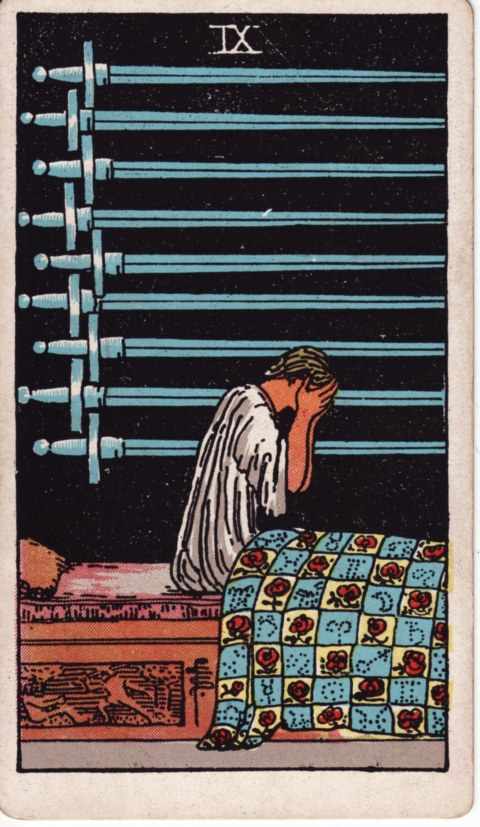
What does the Nine of Swords mean when you cannot sleep?
Upright, the card shows the hour when the mind has the floor. Waite sets the scene in one line, "One seated on her couch in lamentation, with the swords over her," and then closes it with "It is a card of utter desolation." Nothing in the room attacks the sitter: the blades hang in the dark and the bedding is ordinary, so the grief is all in the head. Tarot.com calls it "the official card of 3 am," and that sleepless-night reading is the usual modern one.
Labyrinthos describes the loop from inside: the suit of the mind turned against itself, with questions that multiply until you are haunted by what could be. Biddy Tarot adds the warning that the fear can become a "self-fulfilling prophecy." Someone who expects the worst starts acting as if it had happened, and the behavior can bring on part of the result.
Waite's list is wider than worry, though. "Death, failure, miscarriage, delay, deception, disappointment, despair" are mostly events, and some of them may sit behind the nights. So before you treat the card as pure overthinking, ask what is happening in daylight. A loss, a failure or a long wait can be the real weight, and the card then asks you to name it.
Nine of Swords reversed: is the fear real or only loud?
Reversed, the Nine of Swords splits three ways. In the first the worst has passed: Biddy Tarot says you may have worked through the worry and begun to relax, and Tarot.com pictures someone finally reaching out or journaling. In the second the anxiety goes underground, into suppressed shame and burnout. The third is Waite's own: "Imprisonment, suspicion, doubt, reasonable fear, shame."
The word to stop on is "reasonable." Biddy Tarot tells the reversed reader to "evaluate which fears are warranted, and which are not," and that sentence is the useful one, because the card can go either way. Waite leaves room for a fear that has grounds. The modern pages lean toward the fear being bigger than the facts. Both can be true on different nights, and neither is a verdict until you test it.
A check for a one-card pull: write the fear as one sentence. Under it list what you have actually seen, read or been told, with dates if you have them. If the list is empty or says only "it feels like," the card is the loud fear without a source, and sleep and one honest conversation are the remedy. If one line could be checked by a stranger, such as an unpaid invoice or a message with a timestamp, the fear is reasonable, and that single item gets an action in daylight: a call or a look at the paper.
Asking whether a partner is cheating? Waite's second list says, reversed, "Good ground for suspicion against a doubtful person." Read it as a prompt to look at your own grounds; it is no finding about anyone. The card cannot see another person's conduct. It shows that suspicion is present and asks whether it rests on something you saw. For a pregnancy or a loss, see the last question below.
Is the Nine of Swords a yes or no card?
| Position | Answer |
|---|---|
| Upright | No, not tonight |
| Reversed | Not yet, check the fear |
Upright, the Nine of Swords answers no, with a time attached: not while you are in this state. Tarot.com lands on NO too, and advises a step back to regain composure. A decision made at 3 a.m. from a worst-case picture is rarely the one you would make at noon.
Reversed, wait. Run the fear check from the reversed section first. If the fear holds up, the honest answer to your question may be no. If it falls apart, the question itself can stand. The old books never pair this card with an answer, so every verdict here is modern practice.
Is the Nine of Swords bad in love and friendship?
In a relationship
Tarot.com puts the love reading as the time "when fears are louder than facts": every text analyzed and the worst assumed, all of it carried in silence. Labyrinthos lists suspicion of the partner and regret from the past. Biddy Tarot's warning about the self-fulfilling prophecy applies here, since a partner who is watched and questioned for months may pull away. Say the fear once, plainly, to the person it concerns, then watch what they do over the next weeks. The story you built overnight is a poor witness.
Single
Single, the card usually sits on an old relationship: replaying what you said, what you should have seen, what you may be blamed for. Labyrinthos adds that the burden may be one you are ashamed to share, and the shame keeps the replay going. Dating while the loop runs tends to turn every pause in a new person's messages into the old ending. Telling one friend the whole story shrinks it faster than a new date does.
As feelings
As someone's feelings, the card describes distress. They may lie awake over the relationship, over something they did, or over you. Guilt and dread are the main notes, with a mind running through outcomes. The card does not say that love is behind it or that they will act. Anxious people go quiet, snap or cling, so fear can look like coldness. Ask, and leave them room to answer.
Lying awake over what you said to a friend
You made a remark at dinner, the friend answered with a thumbs-up, and now it is 3 a.m. and you have decided they are furious. The Nine of Swords is the worst case played on repeat. Between friends it is usually a reading of one short reply, and the card cannot tell you what they feel.
Reversed, Waite lists "reasonable fear", so sort what you have. A fact, such as a changed tone over several days, deserves an answer. A feeling alone does not. Tomorrow morning, send one line: did what I said land badly? Tell me if so.
Reversed in love
Reversed in love, the worst may have passed: you talked, the fear turned out smaller, you sleep again. Or the fear is still there and kept out of sight, and then the question is whether to say it. Waite's "reasonable fear" means it may also have grounds. Check them against facts and take them to the person directly. Ask yourself whether your suspicion stands on something you saw.
Nine of Swords at work and with money
At work the card is pressure that has followed you into bed. Tarot.com ties it to job stress that has moved into sleep and self-worth: questioning your abilities, fixating on a supposed failure, carrying the weight of a tough decision. Labyrinthos adds paranoia and no way of coping. Book T's list includes "Burden, oppression, labour", which fits a workload that never leaves your head. One conversation with a manager, or a written list of what is actually due this week, often shrinks it.
On money, Labyrinthos reads panic and all-consuming worry, and Book T's "want, loss" matches. The useful move is to open the account and write the real numbers, because a fear with numbers can be planned around. Reversed, either the worry has eased because you finally looked, or you are avoiding the unopened letter and the unchecked balance. Waite's "reasonable fear" is a reminder that some shortfalls are real, so look at the statement and do not let dread guess it.
Nine of Swords as advice and as a person
As advice, the card says take the fear out of the dark. Write it down, tell one person, and decide what can be checked after sunrise. If the worry or the sleeplessness has lasted for weeks, a doctor or a counselor will help more than any card.
As a person, it describes someone worn down by their own thoughts. Imagine a man named Tomas who has replayed one sharp email he sent in March every night since and has not once reread it. Rereading would take a minute. Reversed as advice: stop hiding it. Name the fear to someone, or find out whether it has grounds, and if it does, act on that part first.
How to read the Nine of Swords in a spread
With one card, the Nine of Swords says the trouble is loudest in your head, so write the worry down and split it into what you know and what you fear. Looking back, it marks a night, a shock or a long strain the question grew from. Placed as the present, it means the loop is running now. As an outcome it warns that dread will color the choice unless you test it.
In Book T's rules of dignity, Cups and Wands are friends of Swords. Cups beside the card turn the dread toward feeling and comfort, and Wands add drive, so the worry becomes action or burns hotter. Pentacles bring in the practical bill: money, health, a home. As our own reading, not a rule from the old books: beside the Eight of Swords, the loop may follow a time of being stuck. Beside the Ten, the worst may have arrived or be feared outright. Beside the Star, relief may come slowly.
The Nine of Swords among the Swords
Gemini holds the last three Swords in Book T: Eight, "Shortened Force"; Nine, "Despair and Cruelty"; Ten, "Ruin." The Nine sits in the middle of a descent. Force is cut short, the mind turns on itself, then comes the end. The pictures agree. In the Eight a woman stands bound and blindfolded in the open. In the Nine she is free and sits up alone in bed, and Labyrinthos reads her as the same woman, released but haunted by what she went through. In the Ten the figure lies face down under ten blades.
That order makes the Nine the hard Swords card that is still a state of mind and not yet an event. The blades hang in the dark, and none has touched her. It is why the card often reads as a warning and as an invitation: while the swords are still in the dark, something can be done.
- Ace of Swords
- Two of Swords · Peace Restored
- Three of Swords · Sorrow
- Four of Swords · Rest from Strife
- Five of Swords · Defeat
- Six of Swords · Earned Success
- Seven of Swords · Unstable Effort
- Eight of Swords · Shortened Force
- Nine of Swords · Despair and Cruelty
- Ten of Swords · Ruin
- Page of Swords
- Knight of Swords
- Queen of Swords
- King of Swords
Titles after the numbered cards are the Golden Dawn's names for them in Book T.
Symbolism of the Rider–Waite–Smith card
- Nine swords on black. The blades are stacked one above another like bars, pale blue against a flat black field. None reaches the sitter. Biddy Tarot reads the stack as negative thoughts piled one on another.
- Hands over the face. The sitter is upright in bed with both hands pressed to the face. The pose says a bad dream or a bad thought has just woken her. Waite adds that she is "as one who knows no sorrow which is like unto hers," which is the isolation of the night.
- A quilt of roses and signs. Squares with red roses alternate with squares of small astrological signs, which Biddy Tarot describes as outlines of astrological symbols. Book T says of its own picture, "No rose at all is shewn." Smith's picture has roses on the quilt, so life and comfort are still in the room, even though the sitter cannot see them.
- The carved panel on the bed. The bed frame has a carving of one figure overcoming another. Biddy Tarot and Labyrinthos both mention it. Neither Waite nor Book T does, so it is Smith's addition: a quarrel or a defeat built into the furniture, the old hurt the sleeper sleeps on.
- The black background. There is no window, no door and no daylight. The black behind the swords is the only setting, so the card reads as the inside of a mind at night. The colors on the quilt, the bed and the blades stand out against it.
What the oldest sources say
“Death, failure, miscarriage, delay, deception, disappointment, despair. Reversed: Imprisonment, suspicion, doubt, reasonable fear, shame.”
“An ecclesiastic, a priest; generally, a card of bad omen. Reversed: Good ground for suspicion against a doubtful person.”
“Despair, cruelty, pitilessness, malice, suffering, want, loss, misery. Burden, oppression, labour, subtlety and craft, dishonesty, lying and slander. Yet also obedience, faithfulness, patience, unselfishness, etc. According to dignity.”
Waite's upright list is "Death, failure, miscarriage, delay, deception, disappointment, despair." The modern sleepless-night reading drops most of it, so it is worth treating the words as the kinds of loss that can sit behind a worry. The card names the weight and cannot say that any of these is coming. His reversed list is the interesting one: "Imprisonment, suspicion, doubt, reasonable fear, shame." The §4 lines are odd. "An ecclesiastic, a priest; generally, a card of bad omen" has no priest in the picture, and the line may be fortune-teller shorthand for an authority or a confessor one dreads facing, though that is only a guess. Reversed, "Good ground for suspicion against a doubtful person" is the same "reasonable fear" in another form.
Book T draws no sleeper at all. Eight swords are held by four hands "with the points falling away from each other," and a fifth hand holds a ninth upright in the centre "as if it had struck them asunder." Then comes the line the modern pages drop: "No rose at all is shewn," and the rose is "utterly destroyed." The meaning list ends with a turn, "Yet also obedience, faithfulness, patience, unselfishness, etc. According to dignity." So the Golden Dawn keeps a door open: well dignified, the same card is endurance and loyalty under strain.
Nine of Swords and Mars in Gemini: the card's decan
| Suit and element | Swords, Air (Major Arcana card of air: The Fool) |
|---|---|
| Decan | 10° to 20° ♊︎ Gemini, the second ten degrees of the sign |
| Planet of the decan | Mars (Major Arcana: The Tower) |
| Major Arcana card of Gemini | The Lovers |
| Golden Dawn title | The Lord of Despair and Cruelty |
| Place on the Tree of Life | Yesod (Book T: “Illness, suffering, malice, cruelty, pain”) |
Attributions from Book T (Golden Dawn, c. 1892; printed 1912).
Book T gives the Nine of Swords the middle decan of Gemini, the span from 10° to 20° Gemini, ruled by Mars, and the picture carries "the Decan symbols Mars and Gemini." Its title is Lord of Despair and Cruelty. Gemini is air, like the suit. Mars is the planet of force and the cutting edge. Gemini is the sign of the Twins and of the mind that answers itself. One way to put them together is an argument you hold with yourself at night, with the cruelty aimed inward. Book T does not say so, and that is an editorial reading.
The card also belongs to Yesod in Book T, which glosses it "Illness, suffering, malice, cruelty, pain." In Golden Dawn teaching Yesod is the sphere of the Moon, the old planet of night and dreams. The link from there to the nightmare reading is ours, because Book T draws no dreamer.
When the Sun is in the Nine of Swords stretch
| Year | Sun enters 10° | Sun leaves (reaches 20° Gemini) |
|---|---|---|
| 2026 | May 31 | Jun 10 |
| 2027 | May 31 | Jun 10 |
| 2028 | May 30 | Jun 10 |
| 2029 | May 30 | Jun 10 |
This year the Sun crossed the Nine of Swords stretch of the zodiac (10° to 20° Gemini) from May 31 to June 10, 2026. Next time: May 31 to June 10, 2027 (US Eastern dates).
Dates are US Eastern, from the astronomy-engine ephemeris. Across 35,064 dates from 1930 to 2025, the Sun is in this stretch on 2.9% of them, and at least one of the ten planets is on 19.3%.
Among the slow planets, Saturn crosses this decan in 2001 and 2002 and again in 2031 and 2032 by our calculation. Uranus enters it in May 2028, stays until July 2030 and returns briefly in early 2031. These dates mark when a planet occupies the decan and say nothing about how the card will play out.
Is the Nine of Swords in your birth chart?
Enter your birth date. We show which of the ten planets stood between 10° and 20° Gemini that day, the slice of sky Book T gives this card; add the time if a planet was near the edge.
Enter your birth date above to see your result.
Every planet, angle and house from your birth time: birth chart calculator.
Questions about the Nine of Swords
Is the Nine of Swords a bad card?
Among the heaviest in the deck. Waite calls it "a card of utter desolation" and, in his later list, "generally, a card of bad omen." Yet the sitter is awake and the swords do not touch her, and modern readers treat the card as a call to speak and rest.
Does the Nine of Swords mean anxiety and nightmares?
Usually. Biddy Tarot lists anxiety, depression and nightmares among its keywords, and Labyrinthos reads the sitter as just woken from a bad dream. The card does not predict dreams. It names a pattern of worry that is loudest at night.
What does the Nine of Swords mean as feelings?
Distress: dread, guilt or worry, often kept private. It does not tell you the cause or whether they will act. Reversed, the person is either calming down or hiding how bad it is.
What answer does the Nine of Swords give to a yes or no question?
Upright, no for now, because the question is being asked from fear. Tarot.com also gives a NO. Reversed, not yet: test the fear first.
Which zodiac sign rules the Nine of Swords?
Gemini, in the middle decan (10° to 20°), with Mars as its planet. The Sun crosses that stretch from about May 31 to June 10.
When will the worry end?
No card can date it. May 31 to June 10 only marks when the Sun crosses the decan, and that is a convention. What shortens a worry is usually saying it aloud and checking the facts it rests on.
Does the Nine of Swords mean death or miscarriage?
Waite lists both words, "Death" and "miscarriage," among its meanings, but a card cannot tell you of a death or a pregnancy loss. Most readers use it for grief, dread and loss in a wider sense. On a pregnancy question, a urine test or a doctor can answer where a card cannot.
Sources
- Astronomy Engine: the open-source ephemeris library behind our planet positions, dates and statistics
- A. E. Waite, The Pictorial Key to the Tarot (1911), Wikisource: the divinatory meanings we quote, upright and reversed
- Book T (Golden Dawn), as printed in The Equinox I:8, 1912: the zodiac sign, Hebrew letter, title and short meaning of each card
- Wikimedia Commons: Rider–Waite–Smith tarot deck: Pamela Colman Smith's 1910 card drawings, public domain
- How we create our readings: our own calculation of sign dates, positions and the 1930 to 2025 statistics
Next to the Nine of Swords
In the suit of Swords: Eight of Swords ← Nine of Swords → Ten of Swords.
Gemini on this site: Gemini zodiac sign · The Lovers, the card of Gemini · your full birth chart.
All 22 Major Arcana with their signs and planets, and the minor cards written so far: tarot card meanings.
Written by The Zodiac Atlas editorial team with the help of AI and edited by a person. Quotations are from Waite's Pictorial Key to the Tarot and the Golden Dawn's Book T, both in the public domain; the card picture is a 1910 printing of Pamela Colman Smith's drawing for the 1909 deck. Sun dates and planet positions come from the astronomy-engine ephemeris (tropical zodiac). Tarot and astrology are symbolic traditions; they do not predict events.