What does the Queen of Swords upright want you to see?
Tarot.com opens by saying she "cuts right to the truth." Waite's picture text is less breezy: "her countenance is severe but chastened; it suggests familiarity with sorrow. It does not represent mercy, and, her sword notwithstanding, she is scarcely a symbol of power." So the clarity is earned. She sees plainly because she has stopped hoping things away.
Book T gives her a list that sounds like a good editor: "Intensely perceptive, keen observation, subtle, quick and confident: often persevering, accurate in superficial things, graceful, fond of dancing and balancing." Note the backhanded middle. She is exact about details, and the old text does not promise she is right about everything underneath. The dancing and balancing say she moves lightly and keeps her poise.
In practice the upright card suits a question where you need an accurate account: a contract to read, a review to give, a hard sentence to say once and kindly. Labyrinthos warns that she can come across as "stern and emotionless." Biddy Tarot explains why people still trust her: "you set expectations up front about how you want to be treated." At work she is the auditor, the editor, the judge, or the colleague whose feedback is accurate and unpadded.
Queen of Swords reversed: cold, bitter or too soft?
Reversed, the readings split. Waite's list is moral and harsh: "Malice, bigotry, artifice, prudery, bale, deceit." Today's sites go two ways. Some turn her cold, bitter and critical, the sword used to wound. Others, Biddy Tarot among them, say the reversal means feeling is overruling the head and other people are steering your decisions. One is too much edge, the other too little.
Waite's second list is blunter still: "A bad woman, with ill-will towards the Querent." That is the oldest voice wanting a villain, and the picture gives it little to work with. Book T has the same warning in its own words for an ill-dignified Queen: "cruel, sly, deceitful, unreliable, though with a good exterior." The detail worth keeping is the good exterior. A reversed Queen can sound entirely reasonable while she cuts.
A test you can run with the card alone: write the letter you will not send to the person at the center of your question. Then underline every sentence that is a fact someone else could check, and circle every sentence that is a verdict on character. Mostly circles means the sword is being used to wound, and the fix is to cut the letter down to the underlined lines. Almost no underlines and many hedges ("maybe," "I just feel") means you have softened it until it says nothing, and the fix is to add the one fact you have been avoiding.
Is a certain woman hostile, is an ex on the way back? Those questions stay open after this card. It describes the tone of your own thinking in the situation. Waite's upright list is full of loss, so if the question comes out of a death or a separation, the card is no verdict on you either. Grief that does not ease is something to bring to a doctor or counselor.
Is the Queen of Swords a yes or no card?
| Position | Answer |
|---|---|
| Upright | Yes, with evidence |
| Reversed | Wait, cool down first |
Upright, the Queen of Swords leans yes when you can state the reason in one sentence and point to evidence. Tarot.com also gives her a YES. Her yes is cool and conditional: it applies to the plan that survives an honest read.
Turned over, she says wait. Check how hot the question is. If you are asking out of anger, wait a day; if you are asking out of fear of someone's reaction, gather the facts first. The old sources offer no yes or no here; the answer reflects how the card is read now.
Queen of Swords in love and friendship: does she care about you?
In a relationship
Together, she wants candor. She is the partner who says what she sees, keeps her own space and expects the same honesty back. Waite's list includes "absence" and "separation," and in a couple that can simply mean time apart that you both name out loud. The weak point is the tongue: a true remark delivered at the wrong moment still lands as a cut.
If you are single
Alone, the card often describes you: a person with high standards who has had enough of games. It can also stand for someone who has lost a partner or come out of a long marriage, which is the older meaning. It says what you will not put up with and promises no new person.
As their feelings
As feelings, the Queen means respect, careful judgment and a guarded heart. The person thinks before they speak and may not say much until they are sure. Book T calls her "subtle, quick and confident," so do not mistake quiet for coolness. Judge by what they say plainly, and by whether it matches what they do.
Growing apart from a friend, kindly
You and an old friend now talk twice a year, and both of you pretend that is fine. The Queen of Swords sees it. Waite says her face "suggests familiarity with sorrow", and she does not pad a loss. Upright, she says the true thing plainly and gently: we have drifted, and I still care. That is kinder than months of vague replies.
Reversed, she turns sarcastic or cold, or you agree to every plan so nobody has to say it. Write the honest message once, covering what the friendship was, what it is now, and whether you want a smaller version of it.
Reversed in love
Reversed, love goes sharp or goes silent: sarcasm, a closed door, a partner who keeps a ledger of your mistakes. It can equally be you, so afraid of a fight that you agree to everything. About an ex, the card shows how you handle your side of it. What the other person intends is outside the picture.
Queen of Swords at work and with money
In an office she stands for accuracy. She is the lawyer, auditor, editor, senior colleague or manager who tells you what is wrong in a sentence and what to do about it in the next. With money she reads the whole contract, asks for the terms in writing and keeps feelings out of the number. If you are choosing between offers, list the facts that can be checked and decide on those.
Reversed, the same trait goes wrong in two ways. Feedback can turn into a weapon, or you can swallow a correct objection because you do not want a scene. On a money question, reversed, do not sign or reply while angry: wait a day and then read the terms again.
Queen of Swords as advice and as a person
As advice, say the one true thing plainly, once, and then stop. Do not pad it and do not repeat it. The open hand in her picture matters as much as the sword; in our reading, it asks for your answer in return.
To see her in a person, imagine a bookkeeper named Marta, widowed three years ago, who runs the accounts for a small contractor. She finds an error in an invoice from his biggest client, tells him the same afternoon, and puts the corrected figure on one page. She is kind enough and still does not soften the number. That is the upright Queen. Reversed as advice: before you send the sharp message, take out every adjective.
How to read the Queen of Swords in a spread
Drawn alone, she tells you to separate what you know from what you feel, and to say the first part aloud. Placed earlier in a line, she is a loss that taught you to see clearly, or a person who spoke straight; placed now, a moment for plain speech; placed last, clarity that costs something.
Book T sets one dignity rule that touches her: "Swords are inimical to Pentacles." Beside a Pentacles card her sharpness meets money or property and can turn into a dispute over it. Cups beside her soften the tone, and Wands give her heat. Beside the Two of Swords, she is a truce being held by a clear head; with the Three of Swords alongside, she is the one who can name the sorrow without flinching.
The Queen of Swords among the Swords
The Swords courts split the work of the mind. The Page watches and the Knight charges. The Queen stops charging and judges from what she has lived through, and the King makes rulings. Her Book T title reads "The Queen of the Thrones of Air" and her label is Water of Air, so she is the feeling part of the thinking suit, the one that knows what a decision costs.
Her Book T drawing is grim: "A drawn sword in one hand, and in the other a large, bearded, newly severed head of a man." On Smith's card the head is gone and the hand is open. Whatever the Golden Dawn meant by the trophy, the picture most readers know shows judgment that still reaches toward someone.
- Ace of Swords
- Two of Swords · Peace Restored
- Three of Swords · Sorrow
- Four of Swords · Rest from Strife
- Five of Swords · Defeat
- Six of Swords · Earned Success
- Seven of Swords · Unstable Effort
- Eight of Swords · Shortened Force
- Nine of Swords · Despair and Cruelty
- Ten of Swords · Ruin
- Page of Swords
- Knight of Swords
- Queen of Swords
- King of Swords
Titles after the numbered cards are the Golden Dawn's names for them in Book T.
Symbolism of the Rider–Waite–Smith card
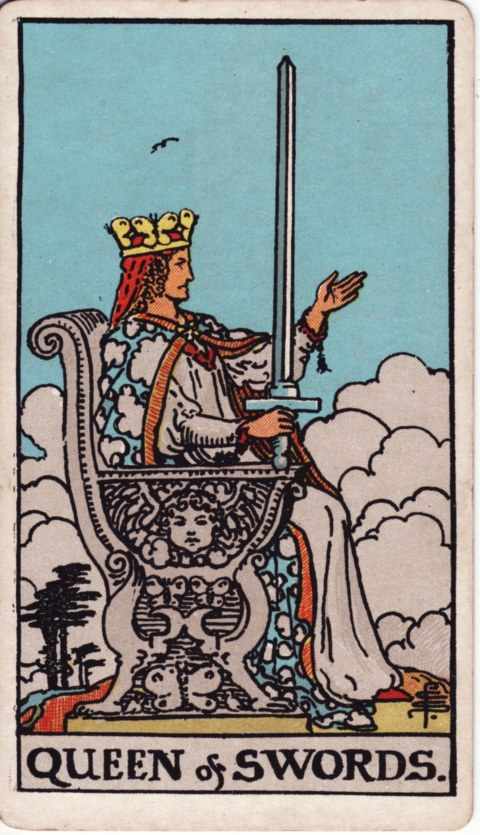
- The upright sword. She grips it with the hilt resting on the arm of her chair, and the blade rises almost to the top of the card. Waite says her right hand "raises the weapon vertically." Held straight, it reads as a statement she is ready to defend, with no strike in it.
- The open hand. Her other hand is raised, palm up and open. Waite writes "the left hand is extended, the arm raised." Book T puts a severed head here. Smith drew an offer in its place, which changes the card from a threat into a request.
- The winged child on the throne. A carved child's face with wings sits at the front of the seat of the grey stone throne. Book T gives the Queen a similar crest, "a winged child's head". A soft face on a hard seat gives the severe queen a trace of tenderness.
- Clouds and cloak. Her blue cloak is patterned with clouds, and white clouds billow around the throne. Book T places "grey cumulus clouds" beneath it. Air is her element, and in the picture she sits above the weather, which reads as a vantage point.
- The single bird and the dark trees. One small bird flies in the upper sky, and a few dark trees stand at the lower left, small and far below. Neither old source mentions them, so what they suggest is an impression only: the distance between the Queen and the ground.
What the oldest sources say
“Widowhood, female sadness and embarrassment, absence, sterility, mourning, privation, separation. Reversed: Malice, bigotry, artifice, prudery, bale, deceit.”
“A widow. Reversed: A bad woman, with ill-will towards the Querent.”
Waite's lists describe loss and say little of a sharp mind. The main one reads "Widowhood, female sadness and embarrassment, absence, sterility, mourning, privation, separation," and the later list condenses it to "A widow." Reversed it turns to "A bad woman, with ill-will towards the Querent." The independent, truth-telling woman of the modern pages is not in either list. Her likely sources are the sword, the airy suit and Book T's intelligent portrait. Waite's picture text agrees with his lists on one point: she suggests "familiarity with sorrow."
Book T is the stranger source. It calls her "Queen of the Sylphs and Sylphides" and gives her a sword and a severed head, then a character that is graceful and observant, with a sly twin if ill dignified. Waite's reversed deceit and Book T's "cruel, sly, deceitful, unreliable" line match each other. In our reading, the widow and the keen observer are the same figure: someone who has seen the worst and no longer flinches.
Queen of Swords in the zodiac: Virgo to Libra
| Suit and element | Swords, Air (Major Arcana card of air: The Fool) |
|---|---|
| Part of the zodiac | 20° Virgo to 20° Libra |
| Book T | Water of Air |
Attributions from Book T (Golden Dawn, c. 1892; printed 1912).
For the Queen of Swords Book T gives her thirty degrees of the zodiac: "Rules from 20 Degree Virgo to 20 Degree Libra." Her elemental label is Water of Air, and her title is "The Queen of the Thrones of Air." Among the trumps, The Hermit belongs to Virgo, Justice to Libra and The Fool to air. A Hermit's solitude and Justice's scales both fit her: she weighs alone.
By Book T's decans, three numbered cards sit inside: the Ten of Pentacles (Wealth, Mercury, the last part of Virgo), the Two of Swords (Peace Restored, Moon) and the Three of Swords (Sorrow, Saturn). Read in sequence they run wealth, a truce, then sorrow, which matches Waite's picture of a woman who has lost something and keeps her head. Book T never lays it out that way. The September equinox falls inside her zone.
When the Sun is in the Queen of Swords stretch
| Year | Sun enters 20° Virgo | Sun leaves (reaches 20° Libra) |
|---|---|---|
| 2026 | Sep 12 | Oct 13 |
| 2027 | Sep 12 | Oct 13 |
| 2028 | Sep 12 | Oct 12 |
| 2029 | Sep 12 | Oct 12 |
This year the Sun crossed the Queen of Swords stretch of the zodiac (20° Virgo to 20° Libra) from September 12 to October 13, 2026. Next time: September 12 to October 13, 2027 (US Eastern dates).
Dates are US Eastern, from the astronomy-engine ephemeris. Across 35,064 dates from 1930 to 2025, the Sun is in this stretch on 8.4% of them, and at least one of the ten planets is on 58%.
Slow planets have crossed the zone. Saturn stood in it in 1950 to 1952, 1979 to 1982, 2008 or 2009 to 2011, and will again in 2038 to 2041. Pluto was there from about 1967 to 1980 with breaks, and Uranus in 1966 to 1973 and again from about 2050 to 2056, by our ephemeris. They are dates on a calendar, nothing more. Use the chart tool under this paragraph to see where the planets stood on your date.
Is the Queen of Swords in your birth chart?
Enter your birth date. We show which of the ten planets stood between 20° Virgo and 20° Libra that day, the slice of sky Book T gives this card; add the time if a planet was near the edge.
Enter your birth date above to see your result.
Every planet, angle and house from your birth time: birth chart calculator.
Questions about the Queen of Swords
Is the Queen of Swords a kind card or a harsh one?
Mostly good upright: honesty, clear judgment, boundaries. Reversed she turns cold or lets feeling overrule the facts. Waite is gloomier than the blogs, and his first word for her is "Widowhood."
What does the Queen of Swords mean as feelings?
Careful, respectful feeling that is thought through before it is spoken. The person may say little. Judge by what they plainly say and do. Reversed, the feeling is guarded, sharp or muddled.
Who does the Queen of Swords stand for?
A direct, independent woman, often older or experienced, or a man with the same manner. Waite also makes her a widow. She can equally be the clear-headed part of you.
What does the Queen of Swords think of me?
As someone to be assessed fairly. She notices details and wants honesty. Reversed, her view is colored by a grudge or by your own mood.
Should I take the Queen of Swords as an answer to yes-or-no questions?
Upright, lean yes when the facts support the plan; Tarot.com gives a YES. Reversed, wait. The old sources set no such rule.
Which sign does the Queen of Swords belong to?
Her zone straddles two signs. Book T runs it from 20° Virgo to 20° Libra and calls her Water of Air. The Sun is in that stretch from about September 12 to October 13.
Does the Queen of Swords say when?
Tarot sets no dates. The stretch from September 12 to October 13, when the Sun is in her zone, is a calendar convention and predicts nothing.
Sources
- Astronomy Engine: the open-source ephemeris library behind our planet positions, dates and statistics
- A. E. Waite, The Pictorial Key to the Tarot (1911), Wikisource: the divinatory meanings we quote, upright and reversed
- Book T (Golden Dawn), as printed in The Equinox I:8, 1912: the zodiac sign, Hebrew letter, title and short meaning of each card
- Wikimedia Commons: Rider–Waite–Smith tarot deck: Pamela Colman Smith's 1910 card drawings, public domain
- How we create our readings: our own calculation of sign dates, positions and the 1930 to 2025 statistics
Next to the Queen of Swords
In the suit of Swords: Knight of Swords ← Queen of Swords → King of Swords.
Virgo on this site: Virgo zodiac sign · The Hermit, the card of Virgo · your full birth chart.
All 22 Major Arcana with their signs and planets, and the minor cards written so far: tarot card meanings.
Written by The Zodiac Atlas editorial team with the help of AI and edited by a person. Quotations are from Waite's Pictorial Key to the Tarot and the Golden Dawn's Book T, both in the public domain; the card picture is a 1910 printing of Pamela Colman Smith's drawing for the 1909 deck. Sun dates and planet positions come from the astronomy-engine ephemeris (tropical zodiac). Tarot and astrology are symbolic traditions; they do not predict events.